3% of Bankers Say AI Has Cost Jobs This Year. 200,000+ Are Projected to Lose Theirs by 2030
The official story from bank executives is that AI hasn't touched headcount yet. Their own hiring plans, and Wall Street's own models, tell a different story.
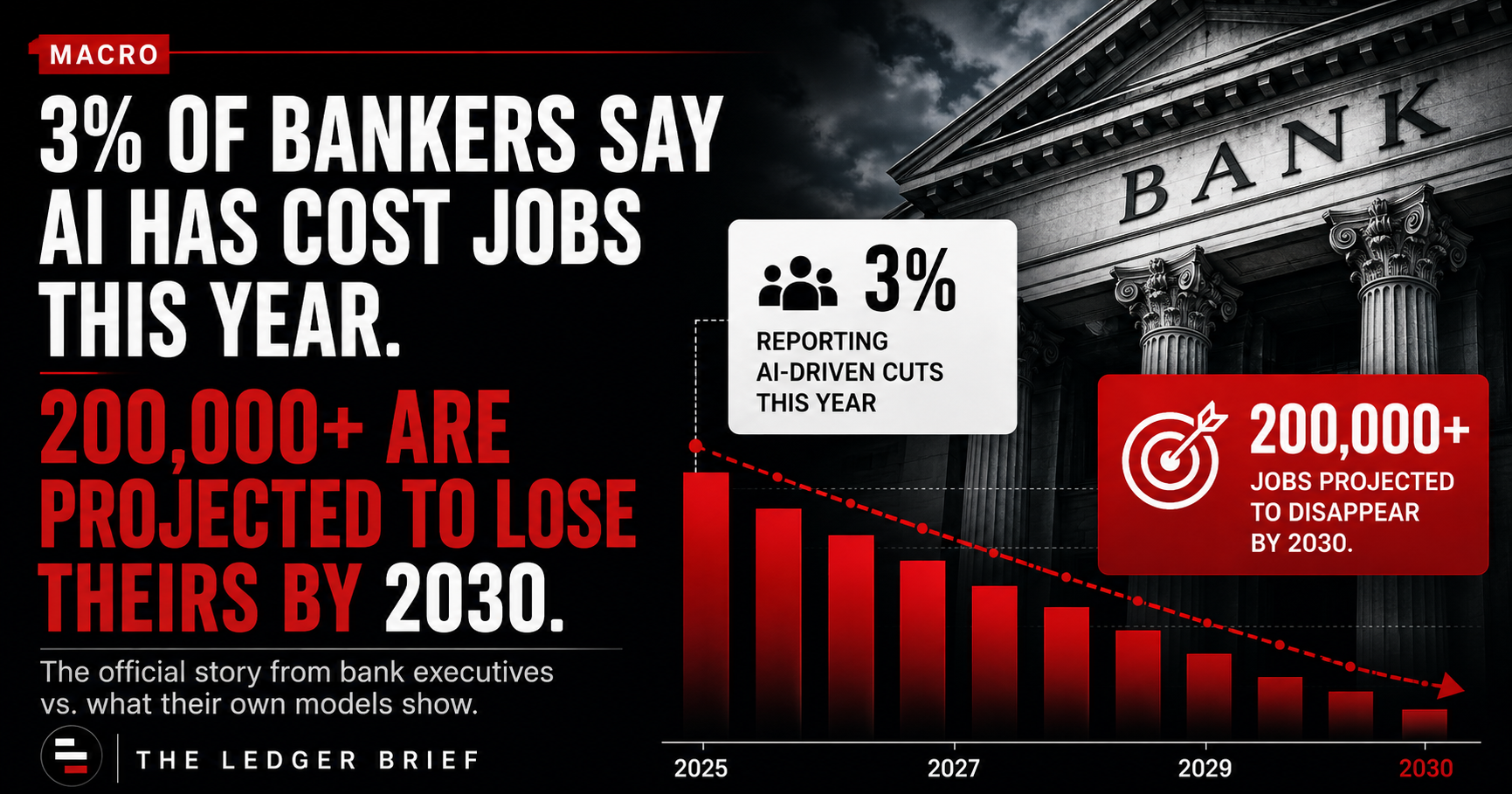
3% of Bankers Say AI Has Cost Jobs This Year. 200,000+ Are Projected to Lose Theirs by 2030.
The official story from bank executives is that AI hasn't touched headcount yet. Their own hiring plans, and Wall Street's own models, tell a different story.
Walk into an investor day at any major bank this year and you'll hear a remarkably consistent message: AI is augmenting our people, not replacing them. It's in the prepared remarks, it's in the talking points handed to line managers, and by most accounts, it's what the people saying it genuinely believe. Ask a bank executive whether AI has cost anyone their job this year, and the answer, overwhelmingly, is no.
A recent industry survey of bank executives found that only 3% said AI had led to workforce reductions at their firm so far. Most described the effect as positive — efficiency gains, faster workflows, roles being augmented rather than eliminated. Only a small minority reported anything resembling a layoff tied directly to AI.
That is the story banks are telling this year. It is not the story they are budgeting for next year, and it is not the story their own internal modeling supports once you look past the press release language.
The forecast doesn't match the present tense
Morgan Stanley's banking analysts, in a report cited by the Financial Times, project that more than 200,000 European banking jobs could disappear by 2030 as lenders lean further into AI and continue closing physical branches. That's roughly 10% of the combined workforce across 35 major banks — not a rounding error, a structural shift on the scale of what branch banking itself went through in the 2010s.
The pattern isn't confined to Europe. Wall Street banks are expected to see a meaningful reduction in headcount over the next several years as AI tools take over work that used to require analysts, and several major U.S. and European banks have already announced five-figure workforce reductions with AI-driven efficiency explicitly cited as a contributing factor, even when it isn't the headline reason given.
The gap isn't between AI working and AI not working. It's between what's happening to headcount this quarter and what's already been modeled for the next five years.
By the numbers
3% of bank executives report AI-driven workforce reductions so far this year
200,000+ European banking jobs projected to disappear by 2030 (Morgan Stanley)
~10% of combined workforce across 35 major banks affected by that projection
5-figure headcount reductions already announced at multiple major banks, with AI-driven efficiency cited as a contributing factor
| 3% |
| 10% |
Where the cuts are actually aimed
The roles most exposed aren't the ones most people picture when they think "AI replacing bankers." It's not the traders or the dealmakers, whose work still leans heavily on relationship management, judgment calls under uncertainty, and regulatory relationships that don't reduce cleanly to a model. It's back-office operations, risk management, and compliance — the unglamorous, document-heavy, rules-based work that algorithms are, frankly, well suited to.
Office and administrative support roles — customer service, tellers, claims processing, reconciliation — make up a substantial share of total financial-sector employment. Those are the roles banks expect AI to absorb first, and they're also the roles least likely to generate headlines when they quietly shrink, because there's no single dramatic announcement — just a hiring freeze here, a "natural attrition" note there, a role that doesn't get backfilled.
That distinction matters if you're trying to read the sector correctly. A bank can genuinely be telling the truth when it says "we haven't laid anyone off because of AI" while simultaneously not replacing people who leave, which produces the same headcount trajectory over a longer, quieter timeline.
Why the gap exists
Part of the disconnect is timing. Deploying AI at bank scale — with the compliance review, the model validation, the integration into decades-old core banking systems that were never designed with modern APIs in mind — takes years, not quarters. The workforce reduction lags the technology decision by design, sometimes by a considerable margin.
Part of it is also incentive. No bank wants to be the first to publicly attribute layoffs to AI while regulators and the press are actively scrutinizing exactly that connection. It's easier, and safer from a public-relations standpoint, to describe headcount reductions as "efficiency initiatives" or "restructuring" than to say "the algorithm did it" out loud in a press release, even when internal planning documents are considerably more direct about the cause.
And part of it is genuine uncertainty. Banks themselves don't always know, in the moment, whether a given reduction is "because of AI" in any clean causal sense, versus a broader cost-discipline push that AI happens to be one tool within. The categories blur in practice even when the survey question asks for a clean yes or no.
What this means for your portfolio
If you hold bank equities for their labor efficiency story, the 2026 numbers are not yet the evidence you're looking for — the cost savings implied by a 200,000-job reduction haven't shown up in expense ratios yet, because the reduction itself hasn't happened yet. That's a multi-year tailwind still ahead of most bank stocks, not behind them, which is worth separating from the narrative that AI-driven bank efficiency is already priced in.
The flip side matters too: banks slower to execute this transition credibly risk a widening cost-to-income gap against peers who move faster, which is a more useful lens for comparing bank stocks within the sector than headline AI adoption claims, most of which sound identical from one earnings call to the next.
What we're watching next
The next 12 months of executive commentary — earnings calls, investor days, workforce guidance — will matter more than this year's survey data. If the "3% today" number starts climbing toward the "10% by 2030" trajectory ahead of schedule, that's the signal the labor shift is arriving faster than banks' own models assumed, and it's worth watching expense-ratio guidance specifically rather than headcount announcements, since the former tends to move first.
Sources
1. American Banker — “Bankers say AI is not eating jobs, yet” (AI Talent Shift Survey 2026)
2. TechCrunch — “European banks plan to cut 200,000 jobs as AI takes hold” (citing Morgan Stanley / FT)
3. Finextra — “Morgan Stanley predicts over 200,000 European banking jobs will be cut by 2030”
Illustrative figures and third-party research cited above; not investment advice.