75% Adoption. 23% Real Impact. Here’s the Gap
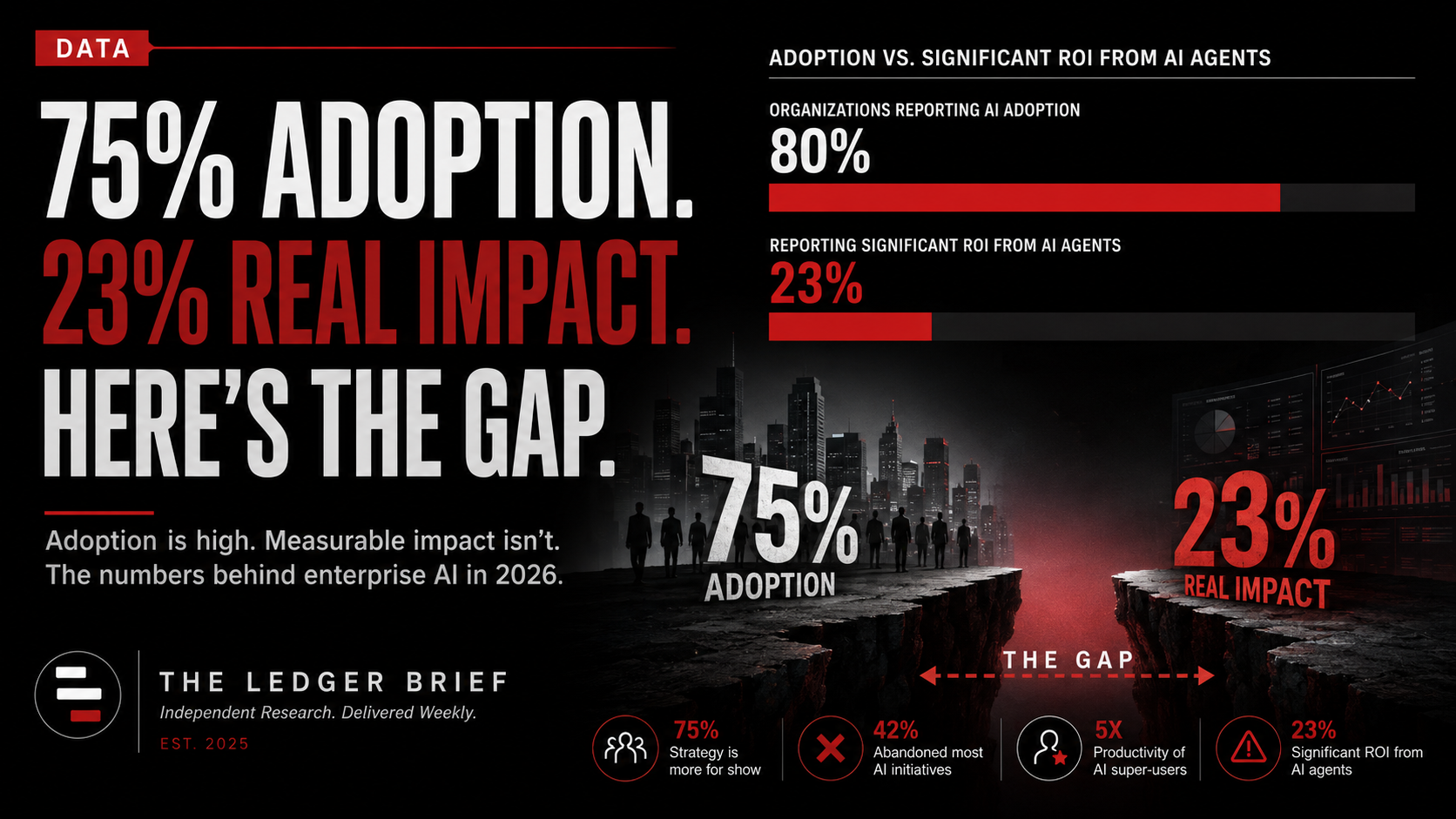
Three out of four companies say they've adopted AI. Fewer than one in four can point to a measurable result from the part of it that matters most. The distance between those numbers is where most of the current AI narrative quietly falls apart.
75% Adoption. 23% Real Impact. Here’s the Gap
Three out of four companies say they've adopted AI. Fewer than one in four can point to a measurable result from the part of it that matters most. The distance between those numbers is where most of the current AI narrative quietly falls apart.
75% Adoption. 23% Real Impact. Here's the Gap.
Three out of four companies say they've adopted AI. Fewer than one in four can point to a measurable result from the part of it that matters most. The distance between those numbers is where most of the current AI narrative quietly falls apart.
By most counts, enterprise AI adoption is no longer a frontier question. Multiple studies place the share of organizations using AI in at least one business function somewhere between 75% and over 80%, with McKinsey's most recent survey putting regular use at 88%. On paper, this looks like a technology that won its argument decisively, the kind of near-universal adoption curve that usually only shows up in retrospective case studies written years after the fact.
Look one layer deeper, at organizations actually measuring what that adoption produced, and the picture changes considerably. A 2026 enterprise AI survey from Writer found that while individual "super-users" deliver measurable 5x productivity gains, only 29% of organizations report significant ROI from generative AI overall — and just 23% report significant ROI specifically from AI agents, the more autonomous, higher-stakes category of deployment that's generated the most executive attention and the most budget over the past year.
That's the gap in the headline: broad adoption, narrow proof. And it's a gap that's easy to miss if you only read the adoption statistics, which is most of what gets forwarded around.
The strategy is admitting it
This isn't a case of leadership being unaware of the gap, which is in some ways the most striking part of the whole picture. The same survey found that 75% of executives admit their company's AI strategy is "more for show" than genuine internal guidance — a striking admission for something that's simultaneously consuming an increasing share of technology budgets and dominating quarterly strategy discussions. Nearly forty percent of companies have no formal plan to actually drive revenue from AI tools, and 48% describe their adoption results so far as a "massive disappointment," in their own words, not a characterization imposed by outside researchers.
Adoption was never the hard part. Adoption is just permission. The hard part — proving the thing you adopted actually changed an outcome — is the part almost nobody has finished.
By the numbers
75–88% of organizations report AI adoption in at least one business function
29% report significant ROI from generative AI overall
23% report significant ROI specifically from AI agents
75% of executives admit their AI strategy is "more for show" than genuine guidance
42% of companies abandoned most AI initiatives last year, up from 17% the year before
5x productivity gain among individual AI "super-users"
| 80% |
| 23% |
Abandonment is rising, not falling
Perhaps the clearest signal that this gap is real rather than a measurement artifact: 42% of companies abandoned most of their AI initiatives last year, up sharply from 17% the year before. If adoption were translating cleanly into value, abandonment should be falling as organizations find their footing and figure out what actually works. Instead it's accelerating — a pattern more consistent with organizations rushing into deployment, failing to see returns, and pulling back, than with a technology steadily proving itself as it matures.
That reversal is worth sitting with for a moment, because it cuts against the usual technology-adoption story, where early stumbles give way to steadily improving results as best practices spread. Here, the stumbles appear to be getting more frequent, not less, even as the underlying models themselves keep improving on benchmark after benchmark.
A workforce split is opening up underneath the strategy problem
The Writer survey also surfaced something with real longer-term consequences: 92% of C-suite leaders are actively cultivating a smaller group of "AI elite" employees who've become genuinely proficient, while 60% say they plan to eventually let go of employees who don't or won't adopt AI tools. Those "super-users" are reportedly three times more likely to get a raise or promotion and five times more productive than colleagues who haven't kept pace.
That's a meaningfully different story than "adoption failed." It suggests adoption succeeded unevenly — concentrated in a subset of employees and use cases sharp enough to generate the 5x gains, while the broader organizational rollout around them stayed shallow enough to produce mostly "show" rather than substance. The gains are real. They're just not evenly distributed, and most companies haven't figured out how to replicate what the super-users are doing across the rest of the workforce.
Why the internal engineer/executive gap makes this worse
Separate research on the enterprise AI adoption gap found 76% of executives believe their teams have meaningfully embraced AI, while only 52% of the engineers actually building with these systems agree — and 49% say their company isn't meaningfully using AI at all. Executives are, in most cases, telling the truth as they understand it: budgets got approved, tools got purchased, pilots got launched, and all of that is visible from the vantage point of a leadership meeting. Whether any of that translated into changed day-to-day work is a separate question, answered most reliably by the people doing the work, not the people who funded it.
What this means for your portfolio
For any company you're evaluating on its AI story, "adoption" as a stated metric has become close to meaningless as a differentiator — virtually every company in your coverage universe can now claim it truthfully. The 23%-ROI-from-agents number is the more useful filter: companies willing to disclose specific, narrow, measured outcomes from their AI deployments are self-selecting into a smaller and more credible group than the ones offering only adoption percentages and forward-looking optimism.
The abandonment trend also has a second-order read worth tracking: vendors selling broad "AI transformation" platforms are more exposed to the 42%-abandonment pattern than vendors selling narrow, specific tools with a clear, provable use case. That distinction is likely to show up in software vendor churn and renewal rates before it shows up anywhere else in the data.
What we're watching next
Whether the 23%-ROI-from-agents number moves meaningfully over the next two survey cycles, or whether it stays roughly flat while adoption keeps climbing toward saturation. If adoption keeps rising while measured impact stays flat, that's no longer a "the technology is still maturing" story — it becomes a story about whether most organizations ever built the internal capability to convert access to a tool into a changed outcome, which is a much harder problem to fix with a bigger budget.
Sources
1. Writer — 2026 enterprise AI adoption report
2. Vention — AI adoption statistics
3. MindStudio — “The enterprise AI adoption gap: engineers vs. executives”
Illustrative figures and third-party research cited above; not investment advice.