A Jury Just Ruled Ticketmaster Overcharged You $1.72 a Ticket
After a five-week trial, a federal jury found Live Nation and Ticketmaster ran an illegal monopoly over live entertainment and put a specific dollar figure on what it cost fans.
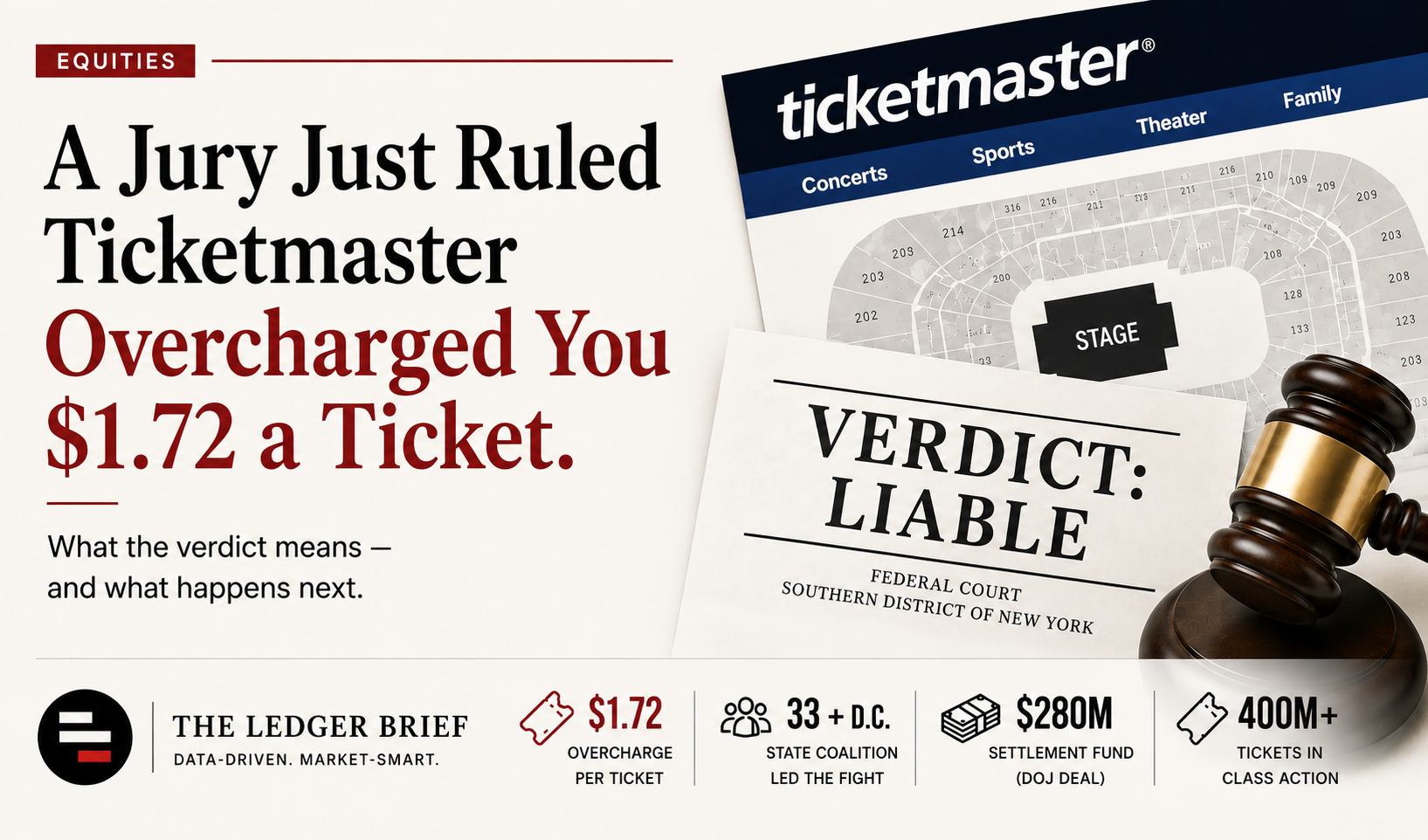
A Jury Just Ruled Ticketmaster Overcharged You $1.72 a Ticket
After a five-week trial, a federal jury found Live Nation and Ticketmaster ran an illegal monopoly over live entertainment and put a specific dollar figure on what it cost fans.

Anurag Soni
August 27, 2026
In partnership with

Stay connected abroad without expensive roaming

Traveling soon? Avoid surprise roaming charges with Saily. Get affordable data plans in over 200 destinations worldwide.
Download the Saily app, select your destination, and activate instantly, no local SIM card needed.
Saily Ultra members enjoy exclusive travel perks including airport lounge access and fast-track services.
Plus, every purchase earns you credits toward your next plan. Built-in ad blocker and security features reduce data usage by up to 28.6%, saving you even more.
Get 24/7 support and a full refund if your device isn't compatible.
Travel smart, stay connected.
Download SAILY in your app store and use code newsletter15 at checkout to get an exclusive 15% off your first purchase.
Chat support available 24/7. Get a full refund if your device isn’t eSIM compatible.
$1.72 OVERCHARGE / TICKET | 33 + D.C. STATE COALITION | 400M+ TICKETS IN CLASS ACTION |
Most antitrust cases end in a settlement, a modest fine, and a company that keeps operating almost exactly as before. On April 15, 2026, a federal jury in Manhattan did something rarer: after a five-week trial, it found Live Nation and its subsidiary Ticketmaster liable on every antitrust count submitted, including illegally monopolizing the primary ticketing market — and it attached a specific number to the harm.
Ticketmaster overcharged fans by $1.72 per ticket, the jury found, across more than 21 states and Washington, D.C.
It's the kind of verdict that sounds almost too tidy to be real — a single, specific dollar figure covering millions of transactions. But it's the product of a case that had been building since a 2022 ticket-sale meltdown made the underlying dysfunction impossible to ignore.
How a bad Taylor Swift presale became a federal antitrust case
The immediate trigger traces back to November 2022, when Ticketmaster's presale for Taylor Swift's Eras Tour buckled under demand, generating site crashes, hours-long queues, and a wave of consumer fury that reached Congress within days. Lawmakers held hearings. The Department of Justice, joined eventually by 40 state attorneys general, filed suit in May 2024, accusing Live Nation of controlling nearly every layer of the live entertainment business — ticketing, venue ownership, and concert promotion simultaneously — in a way that squeezed out competitors and let it charge fans more than a genuinely competitive market would allow.
A company that owns the venues, promotes the shows, and sells the tickets isn't really competing with anyone. It's just deciding, internally, how much of the show's value to keep for itself.
The settlement that fell apart, live, mid-trial
The case took a strange turn in March 2026. Shortly after the trial began, the DOJ reached a surprise settlement with Live Nation — the company would keep Ticketmaster but had to open its venues to competing ticketing platforms, divest several amphitheaters, and cap service fees at 15%, plus contribute to a roughly $280 million state damages fund.
The presiding judge was reportedly unimpressed with how the settlement was disclosed, calling it disrespectful to the court and the jury.
More consequentially: a coalition of 33 states and D.C. rejected the DOJ's settlement outright and chose to keep fighting at trial rather than accept it — a striking split between federal and state enforcers pursuing the same defendant.
| $1.72 Jury's calculated overcharge per ticket |
| $280M Approximate state damages fund in the earlier DOJ settlement |
| 15% Proposed service-fee cap in that settlement |
| 400M+ Tickets covered by a separately certified class action |
What the verdict actually changes, and what it doesn't
A liability verdict is not the same as a remedy. The jury found Live Nation broke the law; a separate remedy phase — plus pending post-trial motions, a required Tunney Act review, and what legal observers consider a near-certain appeal — will determine what Live Nation actually has to do differently, and that process is expected to take years, not months.
The states' potential remedy request reportedly goes well beyond what the DOJ's earlier settlement required, potentially including a structural breakup of the company's ticketing and promotion businesses.
In the meantime, a separate class action covering more than 400 million tickets purchased since 2010 has already been certified to proceed, independent of the antitrust verdict's outcome. Live Nation has also separately settled a deceptive-pricing complaint with Washington D.C.'s Attorney General for $9.9 million, and faces an active FTC complaint over hidden fees and ticket-purchase-limit enforcement.
Why “the fees will just come down” isn't guaranteed
Antitrust experts quoted in the aftermath of the verdict have been notably cautious about promising fans quick relief. A verdict establishing illegal monopoly conduct doesn't automatically translate into lower prices — that depends on what structural remedy the court ultimately orders, how long the appeals process runs, and whether genuine competition actually materializes even if Ticketmaster is required to open its platform to rivals.
What this means for your portfolio
For Live Nation shareholders, the immediate risk isn't the $1.72-per-ticket figure itself — spread across historical ticket sales, even significant damages are unlikely to be existential for a company of Live Nation's size.
The bigger uncertainty is the remedy phase: a structural breakup, forced divestiture of venues, or a hard cap on ticketing fees would each hit the business model differently, and markets generally price uncertainty about which one is coming worse than they price a known, quantified cost. Watch the remedy-phase filings more closely than the headline verdict itself for signal on where this actually lands.
The case also sets a template worth watching beyond Live Nation specifically: legal analysts have flagged that the market definition the states successfully argued — narrowly defining the relevant market as concert ticketing rather than broader entertainment — could become a blueprint for parallel litigation against sports ticketing.
What we're watching next
Whether the remedy phase produces an actual structural breakup or another negotiated settlement that falls short of one — and whether the state-federal split that emerged in this case becomes a more common pattern in future antitrust enforcement.