Can You Retire? Two Experts Disagree by $16,000 a Year on the Same Number
For thirty years, retirement planning ran on a single simple rule: withdraw 4% of your savings each year and you'll be fine. In 2026, the man who invented that rule and the industry's leading retirement researcher looked at the same question and landed $16,000 a year apart on a $1 million portfolio.
Can You Retire? Two Experts Disagree by $16,000 a Year on the Same Number
For thirty years, retirement planning ran on a single simple rule: withdraw 4% of your savings each year and you'll be fine. In 2026, the man who invented that rule and the industry's leading retirement researcher looked at the same question and landed $16,000 a year apart on a $1 million portfolio.
Hiring in a new country? Read this first.

Every country has different employment laws, payroll requirements, notice periods, and benefits expectations.
Oyster's Global Hiring Guides help you navigate the details, avoid surprises, and hire with confidence—wherever you're growing next.
Can You Retire? Two Experts Disagree by $16,000 a Year on the Same Number.
For thirty years, retirement planning ran on a single simple rule: withdraw 4% of your savings each year and you'll be fine. In 2026, the man who invented that rule and the industry's leading retirement researcher looked at the same question and landed $16,000 a year apart on a $1 million portfolio.
Morningstar 3.9% $39K / year | Bengen 4.7% $47K / year | Flexible 5.5% $55K / year |
If you've spent any time thinking about retirement, you've probably encountered the 4% rule: save enough that you can withdraw 4% of your portfolio in your first year of retirement, adjust that dollar amount for inflation every year after, and — according to the historical research behind it — your money should last at least 30 years without running out.
It's a genuinely useful rule of thumb, simple enough to calculate on a napkin, and it's shaped retirement planning advice for three decades. In 2026, it also became the subject of a fairly public disagreement between two of the most credible sources on the topic, and the size of that disagreement is large enough to change what kind of retirement someone can actually afford.
The two numbers, and why they're so far apart
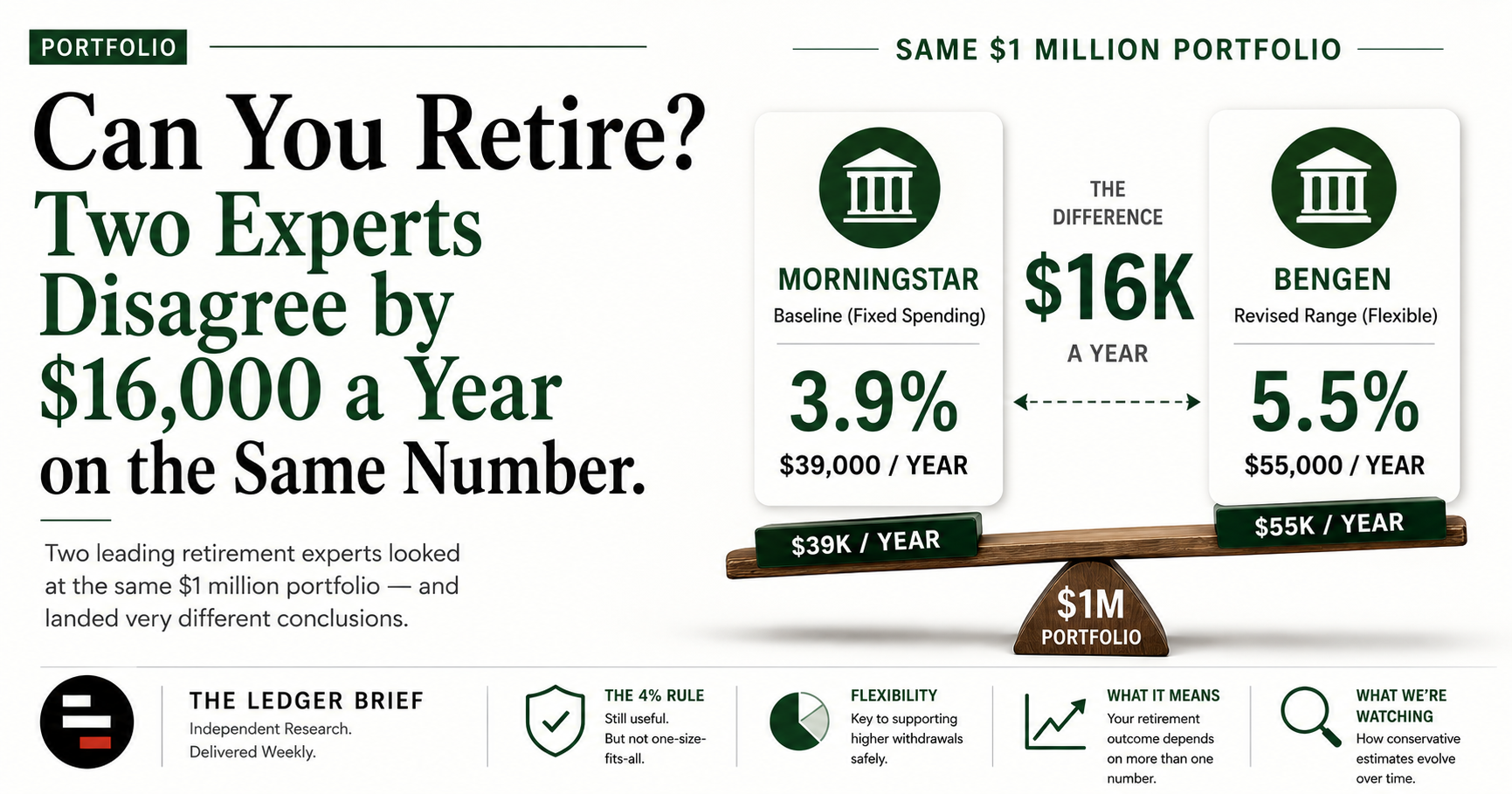
Morningstar's 2026 State of Retirement Income report puts the baseline safe withdrawal rate at 3.9% for a retiree using a fixed spending strategy — meaning withdraw that percentage of your starting balance, then adjust only for inflation every year after, never re-checking against market performance. On a $1 million portfolio, that's $39,000 in year one.
William Bengen — the financial planner who originated the 4% rule in 1994 — has since revised his own number upward. In his 2025 book, he argues that 4.7% is a more accurate worst-case safe maximum for today's retirees, and that retirees willing to adjust spending based on market conditions could reasonably start as high as 5.25% to 5.5%. On that same $1 million portfolio, Bengen's range runs from $47,000 up to $55,000 in year one.
| 3.9% Morningstar fixed-spending baseline · $39,000/year |
| 4.7% Bengen revised worst-case maximum · $47,000/year |
| 5.5% Bengen flexible ceiling · $55,000/year |
| $16K Annual gap between the low and high case |
Why two rigorous analyses can disagree this much
The gap isn't really a disagreement about facts — both sides are working from real historical and projected market data. It's a disagreement about which question is actually being answered.
Morningstar's more conservative figure incorporates forward-looking capital market assumptions — expectations about future returns and inflation that are more cautious than simply extrapolating from history.
Bengen's higher figure leans more heavily on long-run historical sequences and incorporates a wider range of asset classes and diversification benefits than his original 1994 study used. Neither is simply “wrong.” They're answering slightly different versions of the question.
The variable that matters more than either number
Both sides of this debate agree on something more useful than either headline figure: rigid adherence to any single fixed percentage is less important than flexibility.
Morningstar's own research shows that a retiree willing to adjust spending in response to market performance — trimming withdrawals after a bad year, allowing more in a good one — can safely support a rate as high as 5.7%.
The real question isn't “is it 3.9% or 4.7%” — it's how much of your essential spending is already covered by guaranteed income like Social Security or a pension, and how much flexibility you have to trim discretionary spending in a down year.
What this means for your portfolio
If you're within a decade of retirement, this debate is a good prompt to actually model your specific situation rather than anchoring to either 3.9% or 4.7% as a universal answer. The “right” number depends heavily on your time horizon, your asset allocation, and how much of your spending is fixed versus flexible.
It's also worth noting what both sides assume: a diversified portfolio with meaningful equity exposure. An all-bond “safe” portfolio isn't necessarily safe by this research's own definition, because bonds alone may not grow fast enough to keep pace with inflation-adjusted withdrawals over a multi-decade retirement.
What we're watching next
Whether Morningstar's baseline figure continues drifting — it's moved from 3.3%, to 3.7%, to 3.9% across recent editions of the same annual report. If it climbs further toward Bengen's range as market conditions evolve, that convergence would be a meaningfully more useful signal for near-retirees than either individual number is on its own right now.
Have you launched your creator affiliate program this holiday season? Don't miss out on building demand and landing the best partnerships. Levanta's 90-Day Holiday Sprint breaks it all down. Download the Guide.