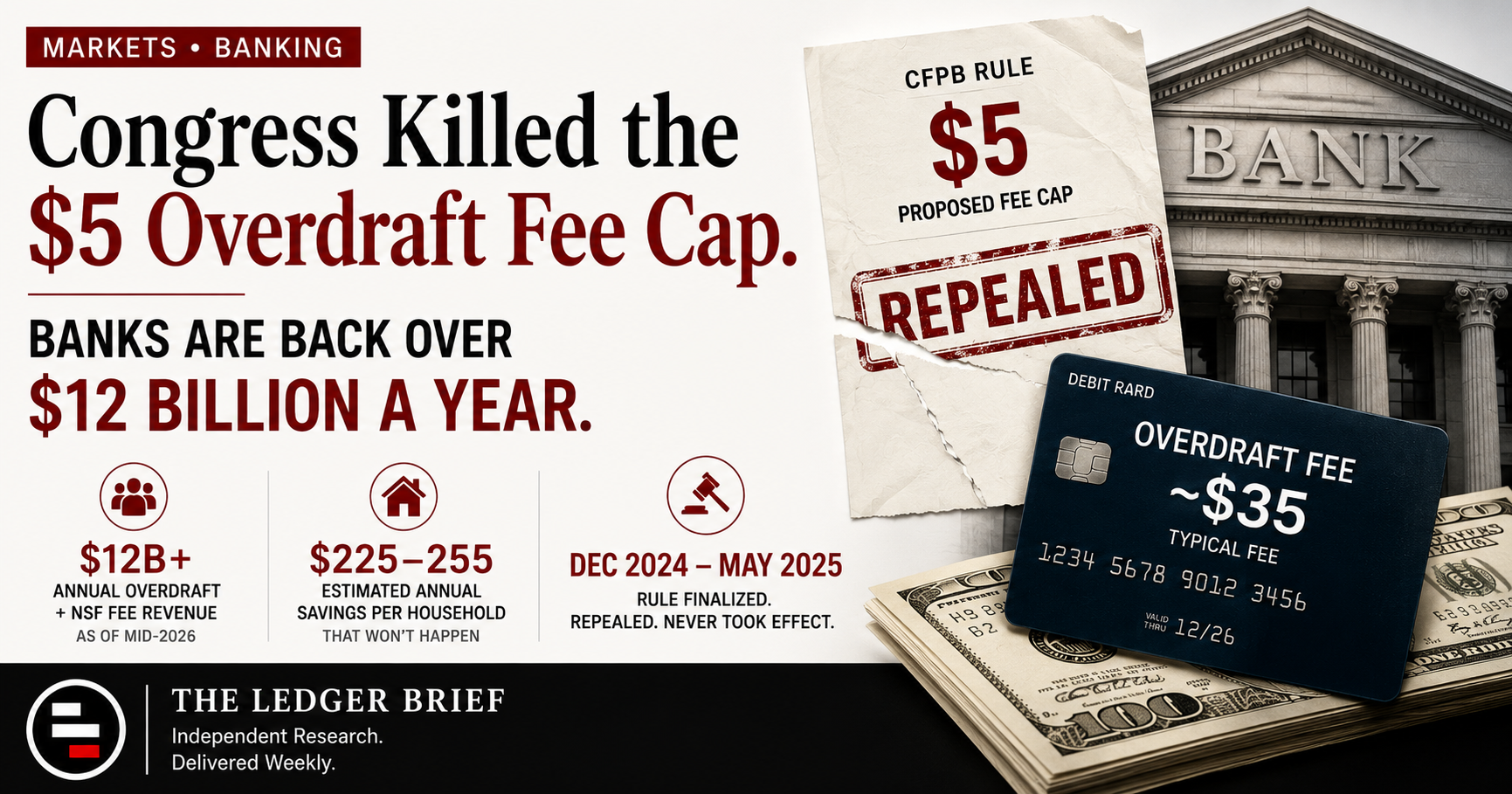
Congress Killed the $5 Overdraft Fee Cap. Banks Are Back Over $12 Billion a Year.
A federal rule would have capped what banks can charge when your account dips below zero. It lasted about five months on the books before Congress repealed it — a fast reversal that split cleanly along party lines and reopened a multibillion-dollar revenue stream.
Congress Killed the $5 Overdraft Fee Cap. Banks Are Back Over $12 Billion a Year.
A federal rule would have capped what banks can charge when your account dips below zero. It lasted about five months on the books before Congress repealed it — a fast reversal that split cleanly along party lines and reopened a multibillion-dollar revenue stream.

Anurag Soni
August 30, 2026
Sponsored by

Stop Paying for 6 Tools. One AI Does It All

Most e-commerce sellers are running their store across 6 to 8 separate tools — and paying hundreds of dollars a month for the privilege. StoreClaw replaces your entire stack with one autonomous AI engine that monitors competitors, optimizes listings, automates marketing, and tracks real profit across Shopify, Amazon, and beyond.
It doesn't wait for you to ask. It runs 24/7 in the background, so you wake up to a full dashboard instead of a list of things you forgot to check.
Connect your store, and StoreClaw gets to work — no prompts, no complex setup, no six-app stack.
Free to start. No credit card required.
CFPB RULE $5 proposed fee cap | → REPEALED | TYPICAL FEE ~$35 banks can still charge |
INDUSTRY OVERDRAFT + NSF FEE REVENUE $12 Billion+ | Back near pre-rule levels by mid-2026. |
DEC 2024 CFPB finalizes rule | MAY 2025 Congress repeals it | OCT 2025 planned start date |
Overdraft an account by a few dollars — an autopay that fires a day early, a coffee that pushes the balance negative — and the fee that follows has historically run around $35, regardless of whether the shortfall was five dollars or five hundred.
In December 2024, the Consumer Financial Protection Bureau finalized a rule aimed directly at that gap. Banks and credit unions with more than $10 billion in assets would have to cap the fee at $5, price it to reflect their actual cost, or treat the overdraft as a standard loan subject to normal lending disclosures.
The rule was projected to save consumers roughly $5 billion a year. It was scheduled to take effect in October 2025. It never got there.
How fast the reversal actually moved
Banking trade groups filed legal challenges within 24 hours of the rule's release, arguing the CFPB had exceeded its statutory authority.
Congress then used the Congressional Review Act to overturn it. The House approved the repeal 217–211. The Senate followed 52–48.
President Trump signed the repeal into law on May 9, 2025 — killing the rule before its scheduled October effective date.
A regulation that took most of a year to finalize was reversed in under five months once the political conditions to reverse it existed.
PROPOSED CAP $5 | TYPICAL FEE $35 | FEE REVENUE $12B+ |
The case each side actually makes
Industry advocates argue the $5 limit amounted to a price control that could make overdraft coverage uneconomical, potentially causing institutions to stop offering it and pushing vulnerable customers toward more expensive or less-regulated alternatives.
Consumer advocates argue a flat $35 fee bears little relationship to the actual cost of covering a small overdraft and disproportionately falls on customers who repeatedly overdraft their accounts.
What actually happened to the money
Industry overdraft and non-sufficient-funds fee revenue climbed back above $12 billion annually by mid-2026, essentially returning to its pre-rule trajectory.
A Senate Banking Committee minority staff analysis estimated the repeal cost consumers up to $5 billion in foregone savings in 2025 and another $2.5 billion in the first half of 2026. Those figures are a Democratic committee staff estimate of the counterfactual impact rather than a neutral audit.
What this means for your portfolio
For bank equity investors, overdraft and NSF fee income is a real revenue line that an aggressive federal rule came within months of eliminating for the largest institutions.
This specific regulatory threat has now been removed for at least the duration of the current Congress and administration, absent a new rulemaking effort — something worth factoring into fee-income durability assumptions for large-bank holdings.
What we're watching next
Whether individual banks keep offering lower-cost overdraft alternatives as a competitive advantage without a federal mandate — or whether fee levels simply drift back toward their pre-rule norm now that the regulatory threat has passed.