Delta Airlines Made More Money From Your Credit Card Than From Flying You Anywhere
Swipe an airline-branded credit card at the grocery store, and the airline gets paid — whether or not you ever board a plane. For some of the largest carriers in the country, that arrangement now generates more cash than the entire business of flying does
Delta Airlines Made More Money From Your Credit Card Than From Flying You Anywhere
Swipe an airline-branded credit card at the grocery store, and the airline gets paid — whether or not you ever board a plane. For some of the largest carriers in the country, that arrangement now generates more cash than the entire business of flying does
In partnership with

Winning Startups Aren't Bigger. They're Leaner.

Founders deploying AI agents across sales, marketing, and customer service are closing more with smaller teams. 65% more sales leads. Less headcount.
Download the free Practical Guide to Agentic GTM for Startups and start building the stack your competitors dream of.
Delta Made More Money From Your Credit Card Than From Flying You Anywhere
Swipe an airline-branded credit card at the grocery store, and the airline gets paid — whether or not you ever board a plane. For some of the largest carriers in the country, that arrangement now generates more cash than the entire business of flying does.
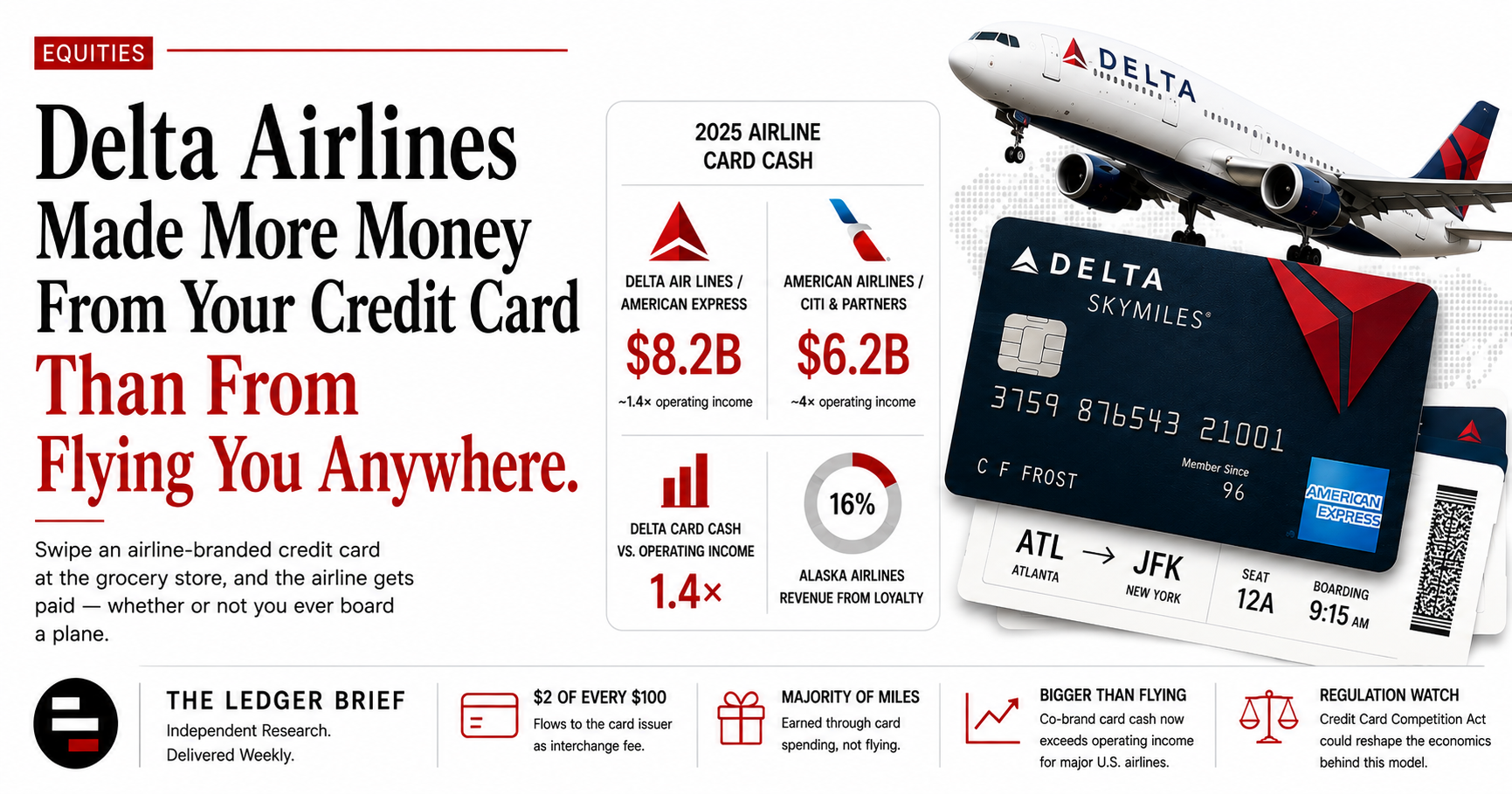
Here's a fact that sounds like a mistake until you check the source twice: in 2025, Delta Air Lines received $8.2 billion in cash from American Express — a figure equal to roughly 1.4 times Delta's entire adjusted operating income for the year. Not 1.4 times some narrow sub-segment. Their whole operating profit, from flying millions of passengers to hundreds of destinations, running one of the most complex logistics operations in the world — and the credit card partnership alone was worth more than all of it combined.
American Airlines isn't far behind proportionally: $6.2 billion in 2025 cash payments from its co-brand and other loyalty partners, roughly four times its adjusted operating income. At Alaska Airlines, loyalty revenue made up about 16% of total revenue — enough that the airline's own CFO has described the co-brand partnership as something that stabilizes results through demand swings, which is a polite way of saying it's carrying real weight when ticket sales get shaky.
How this actually works, mechanically
The mechanics, once you see them laid out, are almost embarrassingly simple. Airlines generate frequent flyer miles at essentially zero marginal cost — they're not a physical good, just an entry in a database — and sell those miles in bulk to banks like American Express, Chase, and Citi. The banks then hand those miles out to cardholders as spending rewards on ordinary purchases: groceries, gas, streaming subscriptions, anything run through the card.
Every time a cardholder swipes, roughly $2 of every $100 spent flows to the card issuer as interchange fee, split between funding the mile rewards and the bank's own profit. The airline gets paid for the miles it sold regardless of whether the cardholder who earned them ever actually flies. A majority of the miles major airlines issue today are earned through card spending rather than through flying — which means, for a large and growing share of any airline's loyalty program, "frequent flyer" no longer accurately describes the person earning the miles.
The mile you earn buying groceries and the mile you earn flying to Tokyo are the same mile in the airline's ledger. Only one of those two purchases required an airplane.
By the numbers
Delta's 2025 cash payment from American Express, about 14% of adjusted operating revenue.
That payment relative to Delta's entire adjusted operating income.
American Airlines' 2025 cash from co-brand and loyalty partners, roughly 4× its operating income.
Share of Alaska Airlines' total revenue attributable to loyalty.
What United cardholders earn on eligible flights starting April 2026, versus 3 for non-cardholders.
Delta / American Express $8.2B | American / Citi & partners $6.2B |
Delta card cash vs. income 1.4× | Alaska revenue from loyalty 16% |
The part that changes how you should read an airline's "profit"
Strip the loyalty and co-brand revenue out of these numbers, and the underlying airline business looks considerably less healthy than the headline profit figures suggest. That's not a hidden scandal — airlines report the split in their filings, and analysts who cover the sector closely already price this in — but it's a distinction that gets lost in casual coverage of airline earnings, where "profitable quarter" gets reported as if it means the same thing at every carrier.
It doesn't. An airline generating a meaningful share of its profit from selling miles to a bank is running a fundamentally different, more financially-engineered business than one generating most of its profit from filling seats at a price above cost. Ryanair's most recent fiscal year — €2.26 billion in profit, driven overwhelmingly by actually flying passengers rather than financial arrangements with card issuers — stands as a useful, almost old-fashioned contrast to the U.S. majors' increasingly loyalty-dependent model.
Why airlines are leaning into this even harder, not less
If anything, the trend is accelerating. United announced that starting April 2026, members without its co-branded card will earn only 3 miles per dollar spent on eligible flights, while cardholders earn at least 6 — and non-cardholders will need a qualifying card just to earn any miles at all on basic economy fares. American Airlines has already stopped giving AAdvantage miles on basic economy tickets entirely for non-cardholders. The message embedded in these policy changes is consistent across carriers: the airline increasingly wants you to be a cardholder first and a flyer second, because the cardholder relationship is worth more to them financially.
What this means for your portfolio
For airline-sector investors, loyalty and co-brand revenue as a share of operating income is arguably a more useful metric than the reported headline profit figure — it tells you how exposed a given carrier is to a completely different kind of risk than fuel prices or passenger demand. A carrier heavily reliant on co-brand card revenue is, in effect, also making a bet on the health of consumer credit spending broadly and on its bank partner's continued willingness to pay premium rates for miles. If a recession hits discretionary card spending, or if a bank renegotiates a co-brand deal on worse terms at renewal, that shows up directly in an airline's bottom line in a way that has nothing to do with how many people wanted to fly that quarter.
This also reframes how to think about airline credit cards as a consumer product, separate from the investing angle: the rewards you earn aren't a gift from an airline that loves you. They're a small cut of a genuinely enormous, deliberately engineered revenue stream, handed back to you specifically to keep you swiping.
What we're watching next
Whether the Credit Card Competition Act — federal legislation aimed at increasing competition in card-payment routing, which would likely compress interchange fees — gains real momentum. If it does, it directly threatens the economics underlying this entire loyalty-revenue arrangement, for airlines and card issuers alike, and would be one of the more consequential pieces of financial regulation for the airline sector specifically that most people watching airline stocks aren't currently pricing in.
Sources
1. Reuters, via Investing.com — “Credit-card cash reshapes US airline loyalty — and profit”
2. TheStreet — “Delta Air Lines made $8.2 billion from your credit card last year”
3. YourStory — “How airline credit cards became more profitable than flying”
Illustrative figures and third-party research cited above; not investment advice.