How Much Are Finance Teams Actually Spending on AI?
The experimentation phase is over. CFOs have moved from "should we spend on AI" to "where exactly is this money going" — and the honest answer is that most of them are still building the tracking to find out
How Much Are Finance Teams Actually Spending on AI?
The experimentation phase is over. CFOs have moved from "should we spend on AI" to "where exactly is this money going" — and the honest answer is that most of them are still building the tracking to find out
How Much Are Finance Teams Actually Spending on AI?
The experimentation phase is over. CFOs have moved from "should we spend on AI" to "where exactly is this money going" — and the honest answer is that most of them are still building the tracking to find out.
Ask a CFO in 2024 whether their finance function was using AI, and you'd likely get a hedge — a pilot here, an experiment there, nothing embedded in how the department actually ran day to day. Ask the same question today, and the hedge is gone, replaced by a level of confidence that would have seemed premature just two budget cycles ago.
Kyriba's 2026 CFO Survey, covering 1,400 global finance leaders, found 91.9% of CFOs are now integrating AI into financial decision-making, either across some processes or virtually all of them. That's not a trend anymore. That's the baseline every finance leader is now measured against, whether they like it or not.
What "spending on AI" actually looks like inside finance
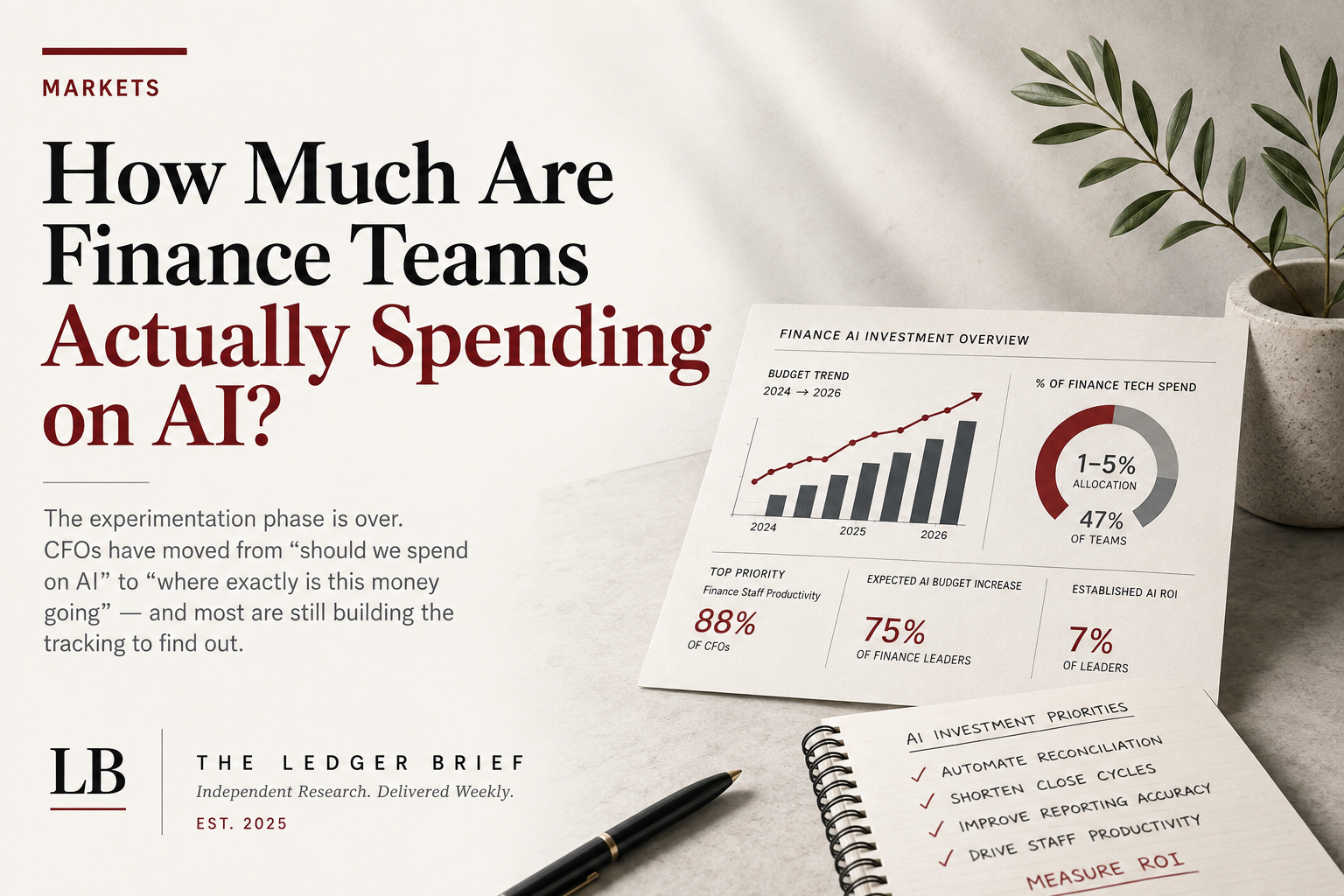
Gartner's 2026 budget benchmarks show nearly 60% of CFOs planning to increase finance-function AI investment by 10% or more this year, with another 24% expecting increases in the 4-9% range. Efficiency is the stated driver — 88% of CFOs rank finance staff productivity among their top three budget priorities, which in practice means automating reconciliation, shortening close cycles, and reducing the manual reporting work that used to consume the first two weeks of every month.
Bain's numbers, drawn from a survey of 264 finance department heads specifically, put the trajectory in sharper relief: about 75% expect their AI budgets to rise this year, and 22% expect a substantial jump rather than an incremental one. That's a level of budget conviction that finance departments — traditionally the most spending-skeptical function in any company — rarely extend to a single technology category.
CFOs stopped asking whether to fund AI a while ago. What they're asking now — quietly, and not always with a good answer yet — is how they'd actually know if it worked.
By the numbers
91.9% of CFOs now integrate AI into financial decision-making in some capacity
~60% are planning finance-function AI investment increases of 10%+ this year
75% of finance department heads expect their AI budgets to rise
47% still allocate just 1-5% of total finance tech spend to AI
7% of leaders report having established AI ROI
3-6 months — typical payback period for management reporting and variance analysis
| 60% |
| 24% |
| 16% |
The number that complicates the story
For all that budget momentum, actual allocation remains modest in absolute terms: Gartner found 47% of finance organizations are putting just 1% to 5% of total finance technology spend toward AI specifically. The headline growth rates are real, but they're growth rates applied to a base that, for nearly half of finance teams, is still small — which changes how you should read every percentage increase reported in a survey like this.
That gap — aggressive percentage increases on a thin base — is worth sitting with. A 30% increase sounds dramatic in a press release. Applied to 2% of a finance technology budget, it's a rounding error in absolute dollars, even though it will show up as an impressive-looking bar chart in next year's investor deck.
The measurement problem nobody's solved
This is where the finance-specific data connects to the broader enterprise AI story: a KPMG Global AI Pulse survey of more than 2,145 senior leaders found only 7% report having established AI ROI, and 42% have only partial visibility into how their AI spending even accumulates across systems and vendors.
Finance teams — the people whose entire professional function is measuring where money goes and what it returns — are, in a fair number of cases, still building the infrastructure to measure their own department's AI spend. There's an irony in that worth noting without belaboring it: the department best equipped to build a rigorous ROI framework is, for the moment, one of the many still operating without one internally.
Where the early payback actually shows up
Not all of it is fog. Management reporting and variance analysis consistently show up as the fastest-paying-back use case for finance-function AI, with payback periods in the 3-6 month range according to multiple CFO surveys — a much shorter and more measurable cycle than the broader "AI transformation" initiatives that dominate press coverage and investor-day slides.
The pattern holds across surveys: narrow, well-defined, high-volume tasks — reconciliation, variance flagging, first-draft reporting, exception detection — show returns that are relatively easy to verify against a clean before-and-after baseline. Broad, ambiguous "AI-powered finance function" initiatives mostly don't, or at least can't yet prove they do, because they were never scoped narrowly enough to measure in the first place.
What this means for your portfolio
For companies you're evaluating, the finance function's own AI maturity is a reasonably good proxy for organizational discipline more broadly — a CFO's office that can point to a specific 3-6 month payback on a reconciliation tool is signaling something different than one that talks about AI transformation in the abstract without a number attached. That distinction is worth listening for on earnings calls, where it tends to be more revealing than the AI mentions themselves.
For the software vendors selling into this market, the 1-5%-of-budget number is the more important one to watch than the growth-rate headlines. Vendors whose pricing models assume finance departments will keep expanding AI budgets at 2026's percentage rates indefinitely are betting on a curve that's currently applied to a very small base — and that curve bending toward a larger base, rather than just a faster percentage, is the real signal to watch for in vendor revenue guidance over the next several quarters.
What we're watching next
Whether the 1-5%-of-budget cohort grows into double digits over the next 12-18 months, or whether the ROI-measurement gap causes budget growth to plateau before it gets there. Gartner's next benchmark cycle will be the first real test of whether 2026's spending intentions survive contact with 2026's actual, measured results — and whether "we increased AI spend by 15%" starts getting followed, in earnings calls, by a specific number showing what that spend returned.
Sources
1. Bain & Company — “CFOs funded the AI revolution. Now they are joining it.”
2. Gartner — 2026 CFO budget plans research
3. Kyriba — 2026 CFO Survey
4. KPMG Global AI Pulse — as covered by Beri
Illustrative figures and third-party research cited above; not investment advice.