Mastercard Scans a Trillion Data Points Before Your Card Is Even Swiped
In under 50 milliseconds, Mastercard's newest fraud model weighs a trillion signals to decide whether your transaction is really you. The same technology arms race is quietly playing out on the other side of the counter, too.
Mastercard Scans a Trillion Data Points Before Your Card Is Even Swiped
In under 50 milliseconds, Mastercard's newest fraud model weighs a trillion signals to decide whether your transaction is really you. The same technology arms race is quietly playing out on the other side of the counter, too.
Mastercard Scans a Trillion Data Points Before Your Card Is Even Swiped
In under 50 milliseconds, Mastercard's newest fraud model weighs a trillion signals to decide whether your transaction is really you. The same technology arms race is quietly playing out on the other side of the counter, too.
Every card swipe, tap, or online checkout triggers a decision most people never think about: is this transaction real? Mastercard already answers that question roughly 143 billion times a year through its Decision Intelligence system — a number so large it's easy to read past without registering what it actually represents: nearly 400 million transaction risk assessments, every single day, most of them invisible to the person holding the card.
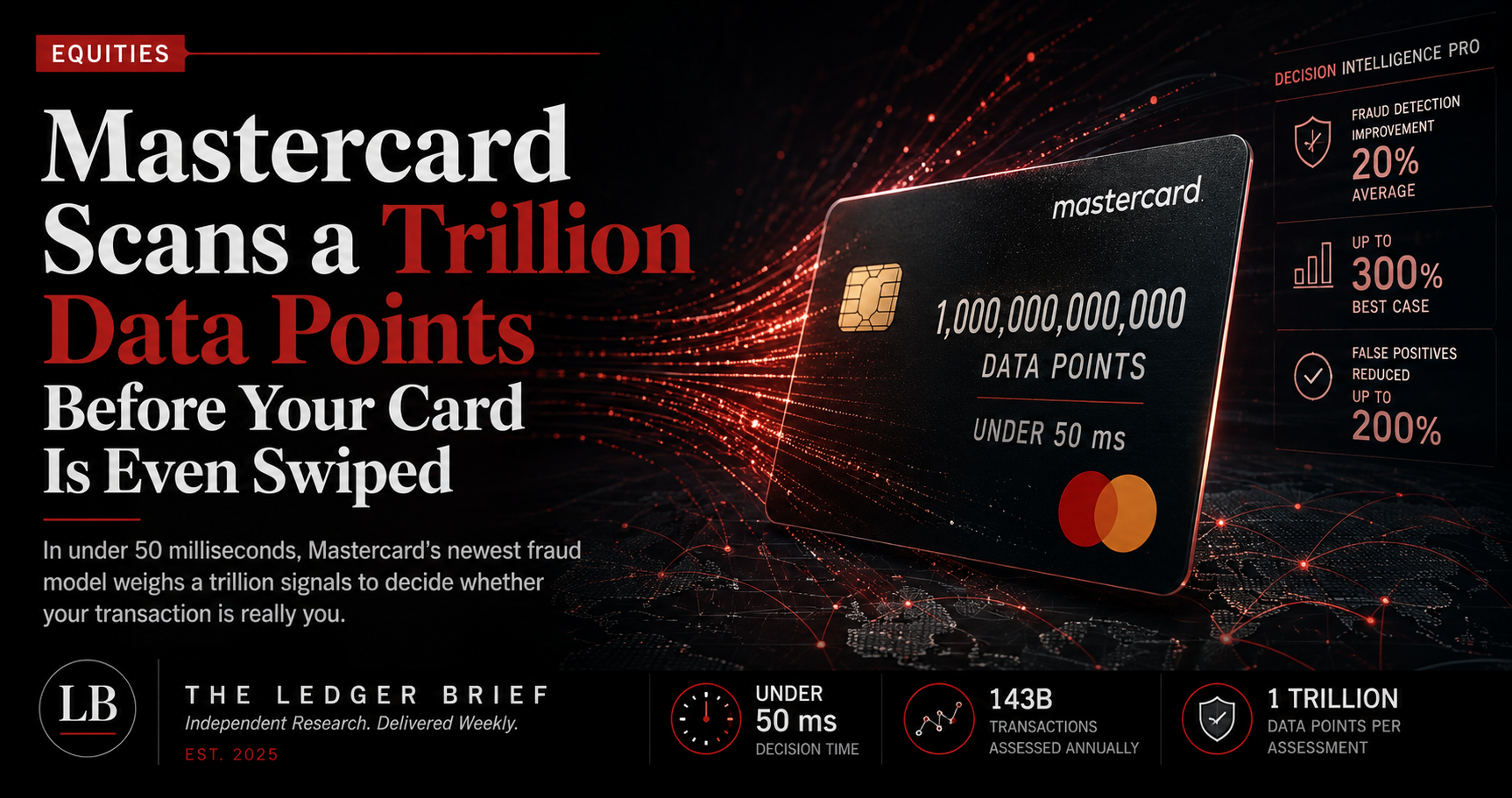
Its newest version, Decision Intelligence Pro, raises the scale of that question considerably — scanning an estimated one trillion data points per assessment, in under 50 milliseconds, to score the likelihood that a transaction is genuine. Fifty milliseconds is faster than a blink. It's also, per Mastercard's own modeling, meaningfully more accurate than what came before it: the company reports fraud detection rate improvements averaging 20%, and as high as 300% in specific scenarios, along with a reduction in false positives — legitimate transactions incorrectly flagged — of up to 200%.
Why the false-positive number matters as much as the fraud number
It's tempting to read a fraud detection story purely as a security story. The false-positive reduction is arguably the more commercially important number of the two, even though it gets far less attention in coverage of this technology. Every legitimate transaction a system incorrectly blocks is a customer standing at a register, embarrassed, while their card gets declined for no real reason — and a meaningful share of those customers, once burned, quietly reduce how much they use that card afterward without ever filing a complaint that would show up in a customer service log.
Cutting false positives isn't just a security win, in other words. It's a retention number wearing a fraud-prevention label, and it's likely to matter more to Mastercard's actual financial results over time than the fraud-catch-rate number that tends to lead the press coverage.
The technology arms race in payments isn't attacker versus defender anymore. It's AI versus AI, with human fraud teams and human fraudsters both increasingly supervising machines instead of doing the work directly.
By the numbers
1 trillion data points scanned per transaction assessment by Decision Intelligence Pro
Under 50 milliseconds — the time it takes to complete that assessment
143 billion transactions scored and approved annually by the base Decision Intelligence system
20% average, up to 300% — reported improvement in fraud detection rates from the AI enhancements
Up to 200% reduction in false positives
$40 billion — Deloitte's projection for generative-AI-fueled U.S. fraud losses by 2027, more than triple 2023's $12.3 billion
| 20% |
| 300% |
| 200% |
The system works by mapping relationships, not just flagging outliers
What distinguishes Decision Intelligence Pro from older rules-based fraud systems is the shift from flagging individual anomalies to assessing relationships between entities — the merchant, the device, the account, the purchase pattern — as a connected graph rather than isolated data points evaluated one at a time. A transaction that looks unremarkable in isolation can look very different once it's assessed against the surrounding network of relationships Mastercard's models have access to, the same way a single puzzle piece means little until you can see how it connects to the ones around it.
This graph-based approach is also how Mastercard has started predicting compromised card numbers before they're used fraudulently — cross-referencing patterns from previously reported fraud and known compromised merchants to flag cards likely to be hit next, rather than only reacting after fraud has already occurred and the damage is already partially done.
The uncomfortable other half of the story
Fraud defense isn't improving in a vacuum — it's improving because the offense is too, and pretending otherwise would make for a much tidier story than the real one. Deloitte estimates that generative AI could fuel $40 billion in U.S. fraud losses by 2027, more than triple the $12.3 billion recorded in 2023. The same generative AI capabilities that let Mastercard model a trillion data points in real time also let fraud rings generate more convincing social engineering scripts, synthetic identities, and automated attack patterns than a human-run fraud operation ever could manage on its own.
That's the actual shape of this story: it isn't AI solving fraud, full stop. It's AI raising the ceiling on both sides of the fight simultaneously, with the outcome determined by whoever's model updates faster and whoever has access to more, and better, training data — which happens to be exactly the kind of scale advantage a company processing 143 billion transactions a year is uniquely positioned to hold onto.
What this means for your portfolio
For payment-network investors, the false-positive reduction is the metric worth pulling out of the fraud-prevention narrative and tracking on its own, because it maps more directly to transaction volume retention and merchant satisfaction than the fraud-catch headline does. A network that measurably reduces wrongful declines has a defensible argument for why merchants and issuers should keep routing volume through it over a lower-cost competitor — that's a moat argument, not just a security feature.
The fraud-arms-race framing also matters for how you read Mastercard's own R&D spend going forward. A company in a genuine capability arms race against increasingly AI-equipped adversaries has a stronger justification for sustained technology investment than one simply keeping pace with industry norms — and that distinction is worth factoring into how durable you expect that spending trajectory to be.
What we're watching next
Whether the false-positive reduction shows up in Mastercard's — and its issuing banks' — customer retention and satisfaction metrics over the next few reporting cycles. A 200% reduction in incorrectly declined transactions is the kind of number that should eventually show up in reduced customer churn and card-of-choice behavior, not just in a fraud-prevention press release. That's the number that would confirm this technology is paying for itself commercially, not just technically — and it's the one that's currently missing from the public data.
Sources
1. Mastercard newsroom — Decision Intelligence Pro launch
2. Mastercard newsroom — “Mastercard Accelerates Card Fraud Detection With Generative AI Technology”
3. Mastercard — “Inside the Algorithm: How Gen AI and Graph Technology Are Cracking Down on Card Sharks”
Illustrative figures and third-party research cited above; not investment advice.