The $1.2 Million Question Nobody Asks Before Picking a Major
A bachelor's degree is, on average, still one of the better financial decisions a person can make. That average is hiding a genuinely enormous range — one where the choice of major matters as much as the choice to attend at all.
The $1.2 Million Question Nobody Asks Before Picking a Major
A bachelor's degree is, on average, still one of the better financial decisions a person can make. That average is hiding a genuinely enormous range — one where the choice of major matters as much as the choice to attend at all.

Anurag Soni
August 27, 2026
Sponsored by

Invest Alongside a Manager with a 40-Year Track Record

Private real estate has long been a cornerstone of institutional portfolios, but individual investors have often had limited access to the asset class - or have had to invest through pooled funds and intermediaries.
Lightstone DIRECT offers a different approach. Accredited investors can invest directly in select real estate opportunities alongside Lightstone, a vertically integrated owner/operator with more than four decades of experience and a $12 billion real estate portfolio.
We invest 20% or more of the equity in every offering, aligning our interests with yours from day one. Our in-house team oversees acquisitions, asset management, and investment execution, with property operations managed by Lightstone and, where appropriate, experienced third-party operators.
No blind funds. No intermediaries. Just direct partnership.
Accredited Investors only. $100k minimum investment.
This communication is for informational purposes only and does not constitute an offer to sell or a solicitation of an offer to buy any securities. Any such offer or solicitation will be made exclusively through the definitive offering documents. All investments involve risk of loss, including the potential loss of principal. Past performance is not a guarantee of future results. Any targeted returns or projections are forward-looking statements, are based on current assumptions, and are not guarantees of future performance. Actual results may differ materially.
"Is college worth it?" has become one of those questions that generates more heat than light — debated at dinner tables, argued about on social media, the subject of dueling op-eds every graduation season.
The honest, if unsatisfying, answer from the people who actually study the data closely is: yes, on average, and it isn't close — but the average is doing an enormous amount of work to hide just how different the answer is depending on what you actually study.
College still wins on average
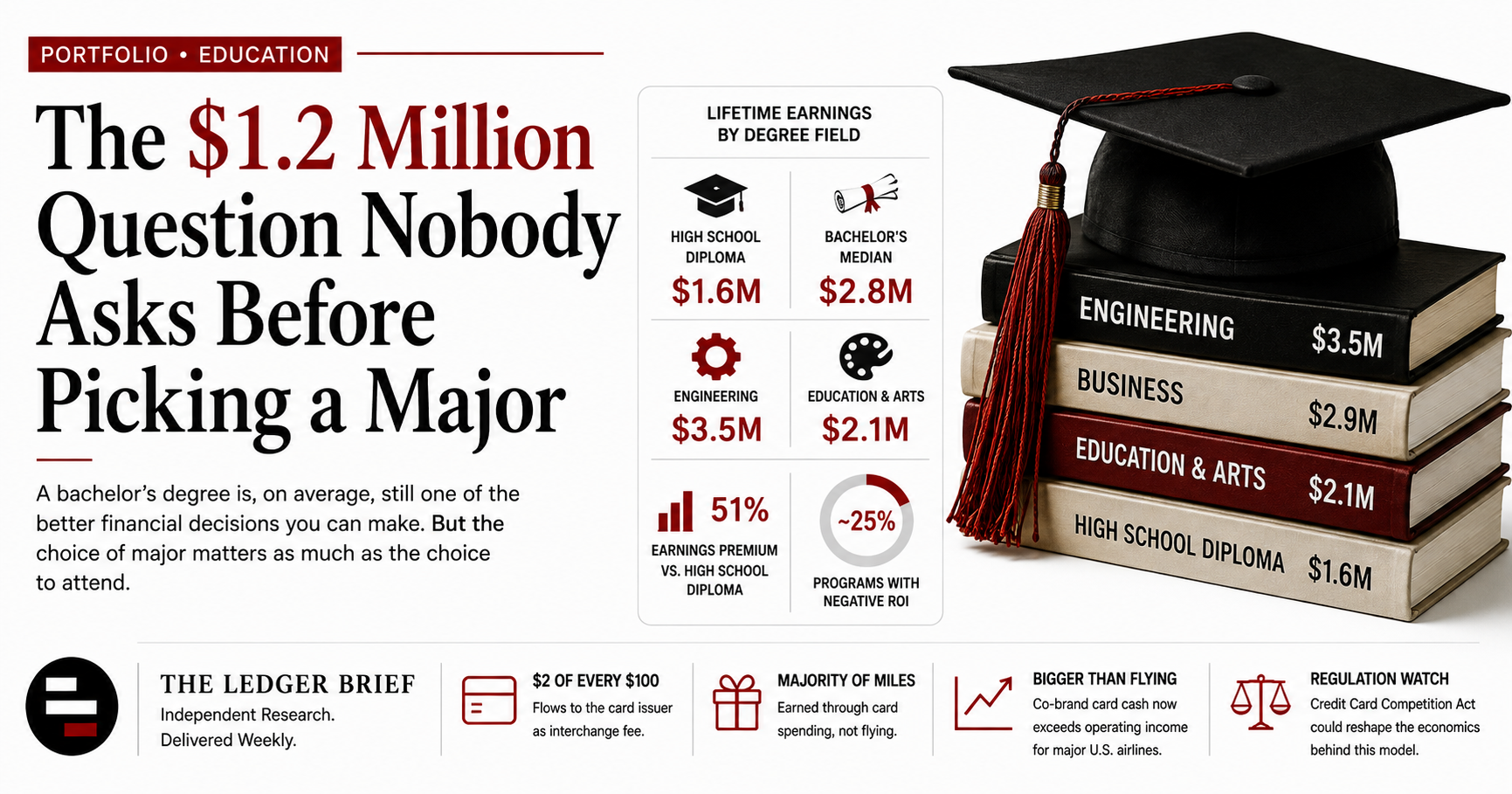
Georgetown University's Center on Education and the Workforce — built on Census Bureau and American Community Survey data — puts median lifetime earnings for a bachelor's degree holder at roughly $2.8 million, compared with $1.6 million for someone with only a high school diploma.
The range hiding inside that average
Stay within the bachelor's degree category, and the spread is where the real story lives. Engineering majors earn a median of roughly $3.5 million over a working lifetime.
Education and arts majors, by contrast, cluster closer to $2.1 million — meaningfully above the high-school-only baseline, but a $1.4 million gap from engineering's median.
The Bureau of Labor Statistics puts a similar gap in more immediately relatable terms: bachelor's degree holders earn a median of $72,830 annually, compared with $48,060 for workers with only a high school diploma — a 51% earnings premium.
The question "is college worth it" has a clear average answer. The question "is this specific major, at this specific cost worth it" is the one that actually determines whether any individual student comes out ahead.
| $2.8M Median lifetime earnings — bachelor's degree |
| $1.6M Median lifetime earnings — high school diploma only |
| $3.5M Engineering majors — median lifetime earnings |
| $2.1M Education & arts majors — median lifetime earnings |
| 51% Bachelor's degree earnings premium over high school |
| ~25% Bachelor's programs one ROI methodology found deliver a negative return |
HIGH SCHOOL $1.6M | BACHELOR'S MEDIAN $2.8M | |
ENGINEERING $3.5M | EDUCATION & ARTS $2.1M | |
Why some majors show up with a negative return at all
A "negative ROI" finding sounds alarming, and one widely cited methodology — comparing typical program cost and debt load against typical starting salary and career earnings trajectory — identifies roughly a quarter of bachelor's programs as delivering a projected financial loss relative to simply not enrolling at all.
But it's a median-graduate, specific-program-cost calculation, not a universal truth about any field.
A student studying education at an in-state public university with minimal debt faces a very different financial equation from someone studying the same subject at a high-cost private institution funded entirely by loans. Same major. Dramatically different ROI.
The detail most "worst majors" rankings leave out
Several of the lowest-ranked majors by lifetime earnings lead disproportionately into graduate programs that meaningfully change the trajectory. A psychology bachelor's degree earning $42,000 at age 25 looks very different from the same student's outcome after a doctorate and a licensed clinical practice paying $100,000 or more by their mid-thirties.
Static undergraduate-major rankings can therefore understate outcomes in fields where an advanced degree is the norm rather than the exception.
What this means for your portfolio
If you're weighing this decision for yourself or helping a family member think it through, a more useful framework than "is college worth it" is a three-part cost breakdown:
| 01 Direct cost Tuition and fees |
| 02 Opportunity cost Wages not earned while enrolled |
| 03 Debt cost Interest accumulated on borrowing |
Those costs should be evaluated against the entry-level and 10-year earnings trajectory for the actual field and institution being considered — not against a national average for college graduates.
What we're watching next
Whether the gap between STEM and non-STEM lifetime earnings continues widening or starts to narrow as AI-driven changes to entry-level knowledge work reshape which specific skills command a premium — a shift that could meaningfully reorder these rankings within the working lifetime of a student choosing a major today.