The Hidden Inflation Inside Your Grocery Cart
The same bag of chips, the same box of cereal, the same price at the register — except it isn’t the same bag anymore. A running tally of what’s quietly disappeared from the package shows up nowhere on the price tag, and almost nowhere in official inflation numbers either
The Hidden Inflation Inside Your Grocery Cart
The same bag of chips, the same box of cereal, the same price at the register — except it isn’t the same bag anymore. A running tally of what’s quietly disappeared from the package shows up nowhere on the price tag, and almost nowhere in official inflation numbers either
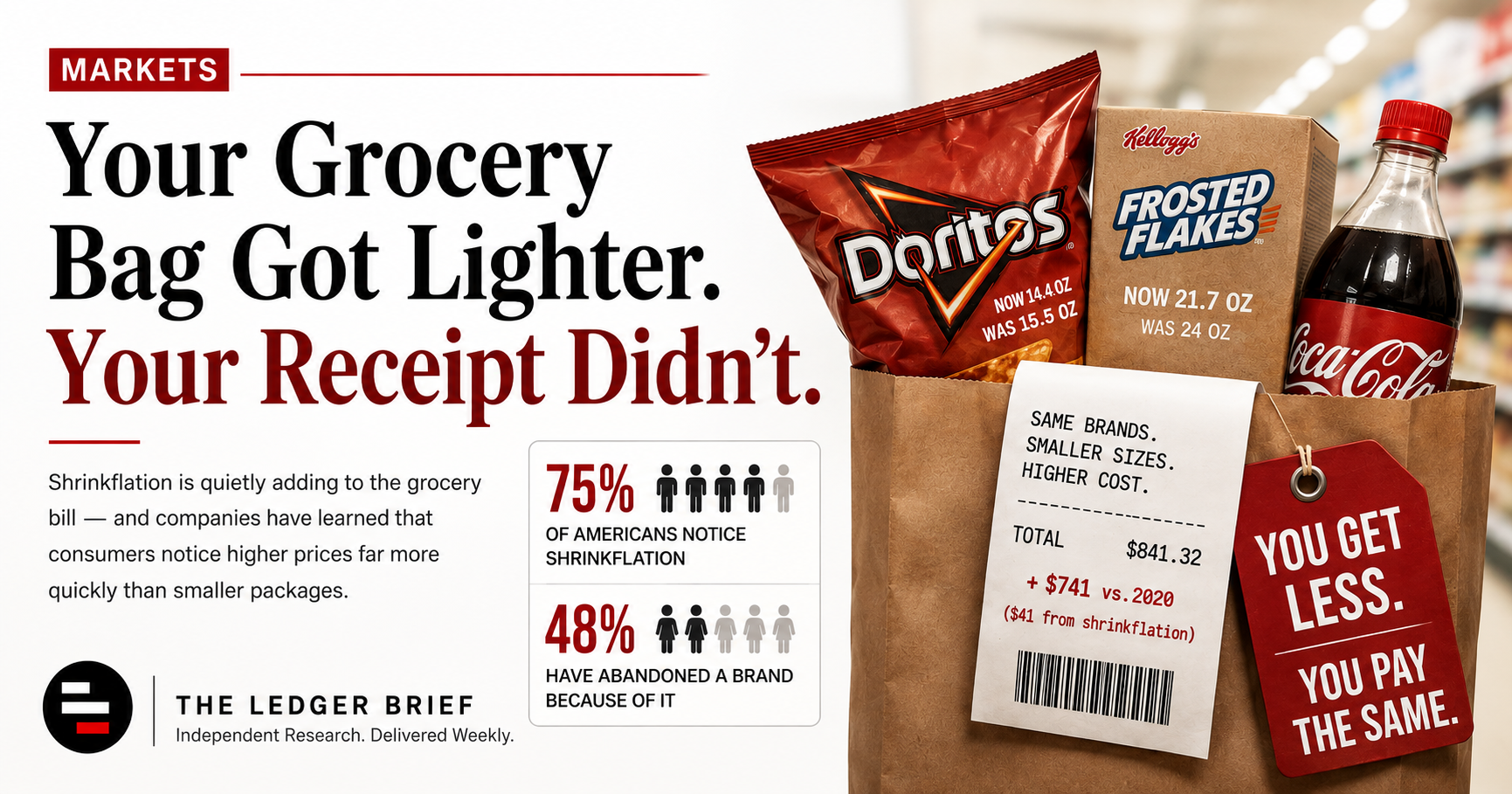
Your Grocery Bag Got Lighter. Your Receipt Didn’t.
Shrinkflation is quietly adding to the grocery bill — and companies have learned that consumers notice higher prices far more quickly than smaller packages.
There's a specific kind of double-take that happens in a grocery aisle: you reach for a familiar bag, and something about it feels wrong before you can say why. It's lighter. Not empty-feeling, just — off. You check the price. Same as always. You check the label. That's when you notice the ounces changed.
This is shrinkflation, and it isn't a conspiracy theory or a one-off gimmick from a single struggling brand. Researchers at InvestorsObserver tracked the prices and package sizes of popular grocery items — Doritos, Frosted Flakes, M&M's, Coca-Cola — from 2020 through 2026, and found the average family of four now pays $741 more per year for the exact same basket of groceries. Of that increase, $41 came specifically from shrinkflation: smaller packages, same price, layered on top of whatever the sticker price itself already went up.
The two-step nobody talks about
The pattern InvestorsObserver documented has a rhythm to it, and once you see it you can't unsee it. A bag of Doritos cost $4.79 in 2021. By 2022 it was $5.99 — a straightforward price hike, the kind that makes headlines and generates complaints. The following year, the price held steady at $5.99. But the bag shrank, from 15.5 ounces to 14.5. By 2026, that same bag costs $6.69, and it's now 14.4 ounces. The price went up twice. The size only went up once, in the wrong direction.
Frosted Flakes followed a similar arc: a box that was 24 ounces in 2020 is now 21.7 ounces, while the price climbed from $3.98 to $5.48. Run the math and the price per ounce is now 51% higher than it was six years ago — even though there was technically a small price dip along the way that made it look, for a moment, like relief was coming.
Why companies do it this way
The logic, from a manufacturer's side, isn't mysterious. Consumers notice price increases immediately and viscerally — a jump from $4.79 to $5.99 generates complaints, comparison shopping, and brand switching in a way that's measurable and immediate. A quarter-ounce reduction in package weight generates almost none of that same reaction, because it requires a shopper to actively compare packaging against memory, something almost nobody does at the shelf in real time.
By the numbers
| 75% |
| 48% |
Why it's invisible in the official numbers, mostly
Government inflation measures do attempt to account for package-size changes — the Bureau of Labor Statistics adjusts for it when it can detect the change — but the adjustment process lags real-world timing, and it depends on the change being reported and captured correctly in the first place. A phys.org-covered academic study found that shrinking package sizes between 2012 and 2019 contributed nearly four percentage points to measured food inflation on its own, separate from headline price increases — meaning a meaningful chunk of "inflation" you've experienced at the grocery store was never really a price increase in the way most people picture one. It was a quantity decrease wearing a price increase's clothing.
The part that hits some households harder than others
Shrinkflation isn't distributed evenly across the population in its effect, even though the packages themselves shrink for everyone the same way. Lower- and middle-income households spend a larger share of their total budget on groceries than higher-income households do, which means the same percentage reduction in package size translates into a larger percentage hit to their overall financial picture. A wealthy household barely notices $41 a year disappearing into smaller bags. A household already budgeting tightly around grocery costs feels every ounce.
What this means for your portfolio
For investors in consumer staples — the Doritos, cereal, and soda makers of the world — shrinkflation is a legitimate and largely successful margin-protection tool, not just a consumer annoyance. When input costs (grain, packaging, transportation, labor) rise, a company facing pressure to protect its margins has two blunt options: raise the sticker price and risk a visible, headline-generating backlash, or quietly reduce package size and absorb the cost increase in a way that's mathematically identical but psychologically much less visible to the end customer.
That's worth watching in quarterly earnings calls and investor presentations: companies increasingly discuss "pack architecture" and "portfolio optimization" as deliberate margin-management levers, not accidents of supply chain pressure. A company that's gotten good at shrinkflation without triggering brand-switching backlash has found a genuinely durable pricing-power tool — and that's a different, quieter kind of pricing power than the sticker-price increases analysts usually track.
What we're watching next
Whether shrinkflation slows as headline inflation cools, or whether it's become a permanent part of how packaged-goods companies manage margins regardless of the broader inflation environment. The grocerycouponguide.com data suggests every brand that shrank a package between 2022 and 2024 kept the smaller size through 2026 — nobody's growing the bags back once the smaller size becomes the new normal. That one-way ratchet, more than any single price hike, is the part worth watching.
Sources
1. WFSB — “Shrinkflation costs average family $41 more per year at grocery store” (InvestorsObserver data)
2. Capital One Shopping Research — “Shrinkflation Statistics: Product Downsizing Data & Trends”
3. Phys.org — “Study reveals shrinking package sizes hide significant food inflation”
4. Cheapism — “How Shrinkflation Is Making You Pay More for Fewer Groceries”
Illustrative figures and third-party research cited above; not investment advice.