Why Your Rent Keeps Rising Even When Nobody's Moving In
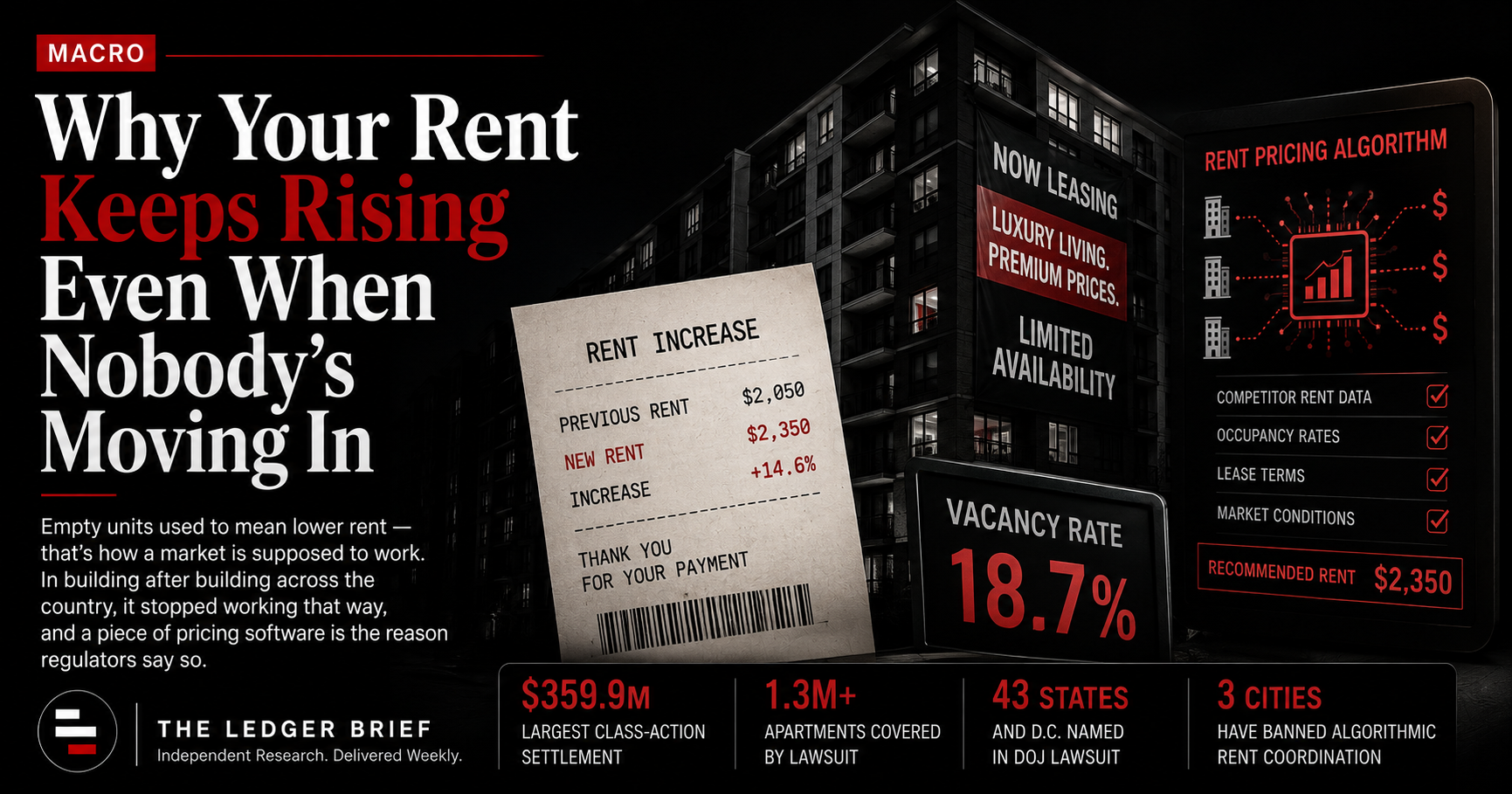
Empty units used to mean lower rent — that's how a market is supposed to work. In building after building across the country, it stopped working that way, and a piece of pricing software is the reason regulators say so.
Why Your Rent Keeps Rising Even When Nobody's Moving In
Empty units used to mean lower rent — that's how a market is supposed to work. In building after building across the country, it stopped working that way, and a piece of pricing software is the reason regulators say so.
Why Your Rent Keeps Rising Even When Nobody's Moving In
Empty units used to mean lower rent — that's how a market is supposed to work. In building after building across the country, it stopped working that way, and a piece of pricing software is the reason regulators say so.
Basic economics says an apartment building with a lot of vacant units should lower its rent to fill them. Empty units generate zero revenue; a slightly cheaper occupied unit generates something. For years, tenants in cities across the country reported something that didn't match that logic: rents kept climbing even in buildings that clearly weren't full, in markets where, by any traditional read of supply and demand, prices should have been softening.
A 2022 ProPublica investigation gave that pattern a name and a mechanism: RealPage, a property management software company whose pricing tool — originally called YieldStar — was collecting nonpublic rental data from competing landlords, feeding it into a shared algorithm, and recommending rent levels back to those same landlords. Legal experts told ProPublica the arrangement could function like cartel-like behavior, just automated and one step removed from any human collusion.
What the algorithm actually did
The mechanism, as described in the Department of Justice's subsequent lawsuit, worked like this: participating landlords fed RealPage nonpublic information — current rents, lease renewal terms, occupancy rates, effectively the data any single landlord would ordinarily have no way of seeing from a competitor. RealPage aggregated that data across its full client base and generated pricing recommendations, meaning a landlord managing a half-empty building could see what similarly-positioned competitors were charging in near-real time, and price accordingly rather than compete on price to fill vacant units.
That's the part that broke the normal mechanism of a market: competition on price requires competitors to not know exactly what their rivals are doing. Sharing that data through a common intermediary, even an automated one, undermines the entire premise.
A market where everyone can see everyone else's next move stops being a market. It becomes a coordination exercise that looks like a market from the outside.
By the numbers
Largest class-action settlement in the case, covering 37 property management companies.
Apartments managed by the six largest landlords named in the DOJ's expanded lawsuit, across 43 states and D.C.
In earlier state-level settlements.
Separate settlements from Camden Property Trust and Mid-America Apartment Communities.
San Francisco, Philadelphia and Minneapolis have moved to ban algorithmic rent coordination outright.
Largest class settlement $359.9M | Apartments under landlords 1.3M+ |
States named in DOJ suit 43 | Largest landlords sued 6 |
How this actually played out in court
The Department of Justice sued RealPage in August 2024, accusing it of enabling illegal price-fixing that reduced competition among landlords. Five months later, the DOJ expanded the case to directly name six of the country's largest landlords, together managing more than 1.3 million apartments across 43 states and the District of Columbia. RealPage itself reached a settlement with the DOJ in November 2025 — no admission of wrongdoing, but three years of court monitoring and new restrictions on how it can collect and use competitor pricing data going forward.
Individual landlords have settled separately and, in some cases, for larger sums than the software vendor whose tool they were using. Camden Property Trust and Mid-America Apartment Communities each agreed to pay $53 million. A broader $359.9 million class settlement covering 37 property management companies opened to claims, covering renters who leased an apartment anywhere in the U.S. between October 2018 and November 2025 — a window wide enough that a meaningful share of American renters over that period may be eligible for a payment, whether or not they ever noticed anything unusual about their lease renewal.
Why cities started banning it outright, rather than waiting for the lawsuits
Litigation is slow, and the harm — however real — is diffuse across millions of individual leases, which makes court remedies imperfect even when they succeed. Several cities decided not to wait: San Francisco, Philadelphia, and Minneapolis have all passed local ordinances specifically banning landlords from using shared pricing algorithms of this kind, independent of how the federal case resolves. Philadelphia's ban has already generated its own class-action lawsuit, filed by a renter alleging his property manager used RealPage in violation of the city ordinance — a sign that local bans are generating their own enforcement mechanism separate from the federal case.
What this means for your portfolio
For investors in residential REITs and apartment operators, the RealPage settlements are a real, quantifiable cost — $53 million here, $359.9 million there — but the more durable risk is structural: several of the largest apartment operators in the country now operate under multi-year monitoring agreements that constrain how they can price units going forward, at exactly the moment several major cities have banned the pricing tool entirely. That's a genuine headwind to the "sophisticated dynamic pricing" narrative that supported rent growth assumptions in a lot of multifamily REIT models over the past several years.
The counter-consideration: none of this necessarily changes the underlying supply-demand fundamentals driving rent levels in supply-constrained metros. Algorithmic coordination may have accelerated and smoothed rent increases, but it didn't invent the housing shortage underneath them. Separating "how much of this rent growth was algorithmic coordination versus genuine scarcity" is exactly the kind of question that's hard to answer cleanly — and worth being skeptical of anyone, on either side of the debate, who claims to have a precise number for it.
What we're watching next
Whether the final approval of the $359.9 million settlement (expected in Tennessee federal court) triggers a broader wave of similar suits against other categories of shared pricing software — self-storage, hotels, and parking have all faced similar allegations in recent years, with less legal attention than housing has received so far. RealPage was the test case not because it's uniquely improper as a business model, but because rent is the expense category most likely to generate a motivated plaintiff.
Sources
1. ProPublica — “Justice Department Sues Landlords for Alleged Price Fixing With RealPage”
2. Top Class Actions — “Did RealPage's software raise your rent?”
3. Multifamily Dive — “Tracking algorithmic rent-pricing lawsuits”
4. Payout — “37 Landlords Fixed Your Rent With an Algorithm. The $359.9M Settlement Is Open.”
Illustrative figures and third-party research cited above; not investment or legal advice.