You Can Do Everything Right and Still Go Bankrupt From a Single ER Visit
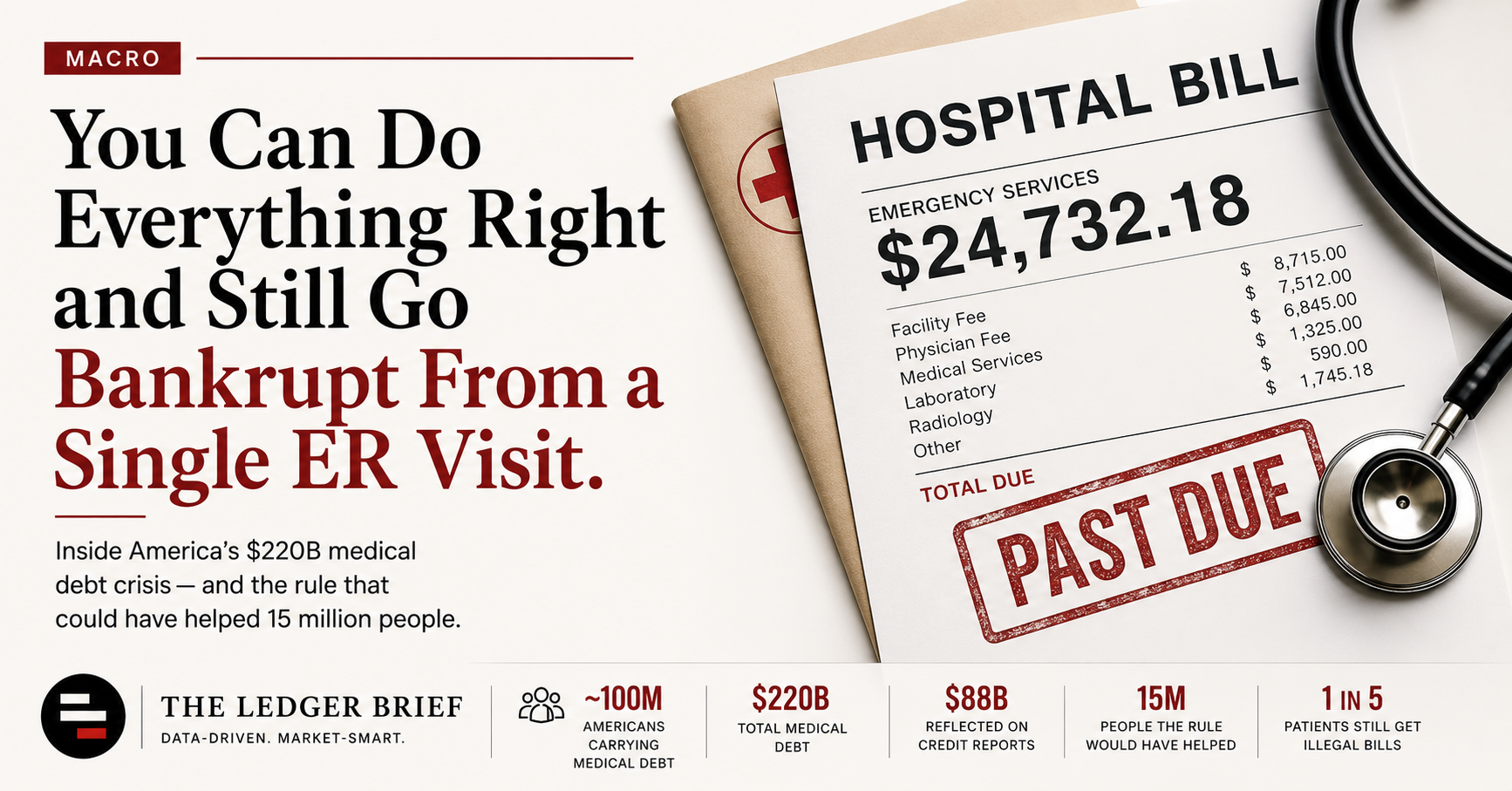
Medical debt is one of the only major categories of American debt that isn't the result of a purchase, a lifestyle choice, or a financial mistake. It's the result of getting sick — and roughly 100 million Americans are currently carrying some of it.
You Can Do Everything Right and Still Go Bankrupt From a Single ER Visit
Medical debt is one of the only major categories of American debt that isn't the result of a purchase, a lifestyle choice, or a financial mistake. It's the result of getting sick — and roughly 100 million Americans are currently carrying some of it.

Anurag Soni
August 28, 2026
In partnership with

Everything GTM. One platform.

Small teams don't have time to stitch together five tools and hope it works.
Apollo gives you everything you need to find leads, reach them, and close deals — all in one place:
230M+ verified contacts
AI-powered outreach
Data enrichment
Inbound lead capture
Meeting scheduler
And more
Stop juggling tools and start building pipeline that scales.
With Apollo, the AI revenue engine powering 4M+ users.
| MACRO |
~100M AMERICANS CARRYING MEDICAL DEBT | $88B REFLECTED ON CREDIT REPORTS | 15M PEOPLE BLOCKED RULE WOULD HAVE HELPED |
Most debt tells a story about a decision. A mortgage means you bought a house. A car loan means you bought a car. Credit card debt, however it accumulated, generally traces back to purchases someone chose to make.
Medical debt is different, and that difference is the reason it occupies its own category in how researchers and policymakers think about household financial distress. Nobody decides to need an ambulance. Nobody chooses an out-of-network anesthesiologist during emergency surgery while unconscious. And yet an estimated 100 million Americans currently carry some form of medical or dental debt — around $220 billion in total.
How it happens to people who “did everything right”
The Consumer Financial Protection Bureau estimates $88 billion in medical debt is currently reflected on Americans' credit reports — and cautions that the true total is almost certainly higher, since not all medical debt gets reported to credit bureaus in the first place.
The burden isn't evenly distributed. Adults living with a disability are more than twice as likely to report medical debt as those without one — 13% versus 6% — while the share carrying medical debt climbs through middle age before declining once people reach Medicare eligibility.
You don't rack up a $90,000 ICU bill because you overspent. You rack it up because you got sick.
| ~100M Americans carrying medical or dental debt |
| $220B Estimated medical debt outstanding nationally |
| $88B Medical debt reflected on credit reports |
| 15M People the blocked CFPB rule would have helped |
| 1 in 5 Patients reporting a bill they believe violates surprise-billing law |
A rule that would have helped 15 million people — blocked before it took effect
The CFPB finalized a rule that would have removed medical debt from credit reports entirely and barred lenders from factoring it into lending decisions — a change the agency estimated would help roughly 15 million people and remove about $49 billion in medical bills from credit files nationally.
The rule was drafted under the Biden administration. After a lawsuit challenged the CFPB's authority to issue it, the incoming Trump administration declined to defend the rule in court and instead sided with the plaintiffs challenging it, effectively ending the rule before it took effect.
The issue has instead fragmented at the state level. As of February 2026, 15 states had enacted their own rules limiting how medical debt can appear on credit reports.
Why the No Surprises Act hasn't fully solved this
Federal surprise-billing protections enacted in 2022 were designed to stop patients from being hit with out-of-network charges during emergencies or procedures where they had little real ability to choose the individual provider treating them.
The law has reduced surprise billing incidents, but it hasn't eliminated them. Roughly one in five patients still report receiving a bill they believe violates the law, while the dispute-resolution process is widely described as too burdensome for an individual patient to navigate without professional help.
What this means for your portfolio
For healthcare-sector investors, the credit-reporting fight is a useful proxy for a broader regulatory pattern worth tracking: consumer-protection rules finalized late in one administration face a real risk of being unwound early in the next.
That pattern isn't unique to medical debt — the same dynamic played out with the CFPB's overdraft fee rule around the same period. Companies and sectors whose business models depend partly on rules that could flip with the next administration carry a form of regulatory risk that's easy to underweight when a rule is newly in effect and easy to overweight once it's been reversed.
For household risk management, the practical takeaway is different: even comprehensive-looking insurance doesn't fully eliminate out-of-network exposure during emergencies. Reviewing what your plan actually covers before you need emergency care is one of the few actionable defenses against a risk that's otherwise largely outside your control.
What we're watching next
Whether more states follow the 15 that have already limited medical debt's impact on credit reports, effectively rebuilding at the state level what the federal rule would have done nationally — and whether that patchwork eventually converges toward something resembling uniform protection or remains permanently uneven depending on where a patient happens to get sick.