You Think You Spend $86 a Month on Subscriptions. You Actually Spend $219
Ask someone to guess their monthly subscription total off the top of their head, then have them actually add up every streaming service, app, and membership one by one. The gap between those two numbers is one of the more consistent findings in consumer research — and it isn't close
You Think You Spend $86 a Month on Subscriptions. You Actually Spend $219
Ask someone to guess their monthly subscription total off the top of their head, then have them actually add up every streaming service, app, and membership one by one. The gap between those two numbers is one of the more consistent findings in consumer research — and it isn't close
You Think You Spend $86 a Month on Subscriptions. You Actually Spend $219.
Ask someone to guess their monthly subscription total off the top of their head, then have them actually add up every streaming service, app, and membership one by one. The gap between those two numbers is one of the more consistent findings in consumer research — and it isn't close.
Ask most people how much they spend on subscriptions each month, and you'll get a fast, confident answer: somewhere around $80 or $90. It's a reasonable-sounding number — a streaming service or two, maybe a gym membership, a cloud storage plan.
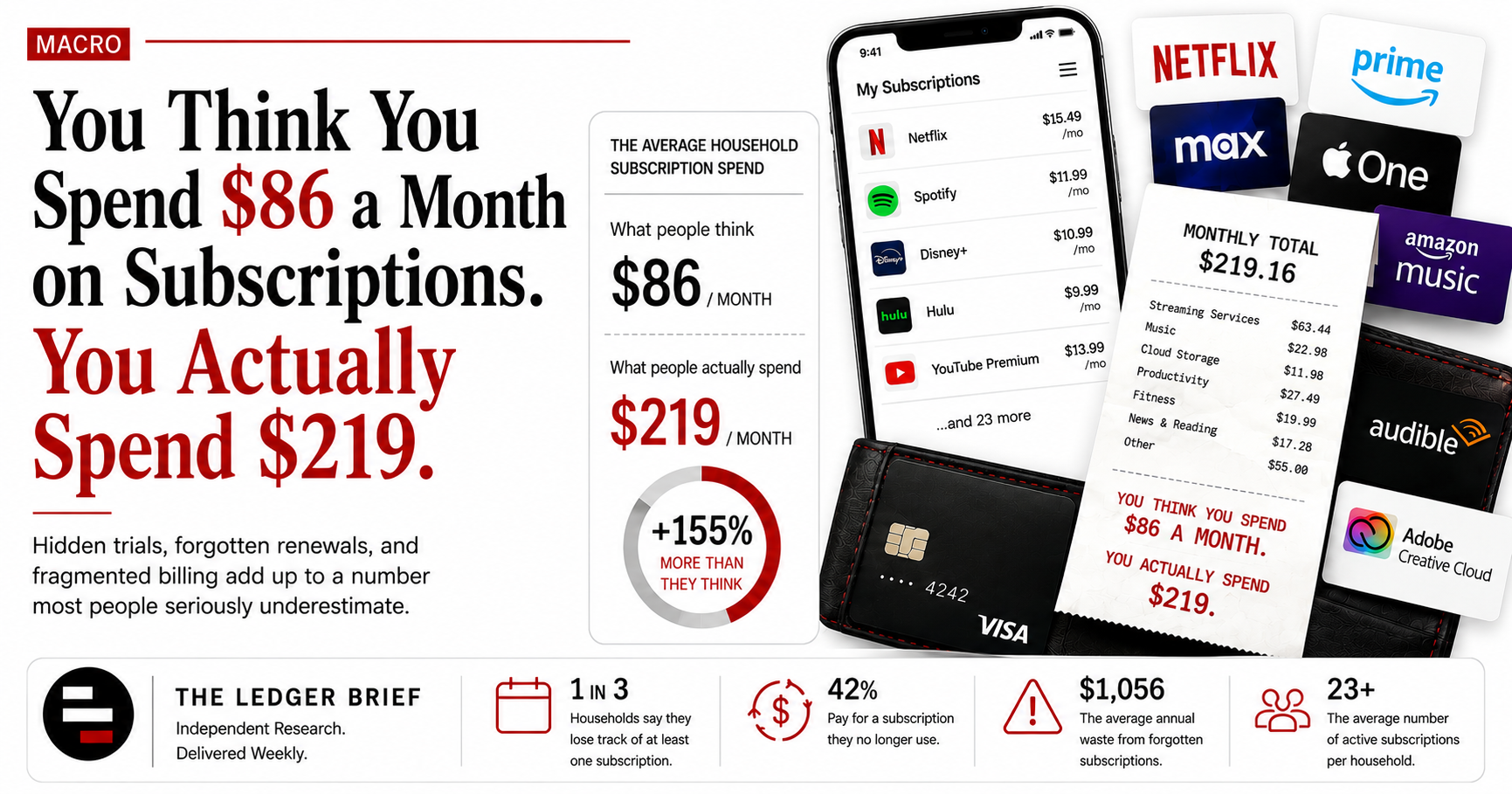
Then have them go category by category — streaming, music, fitness, food delivery, cloud storage, news, gaming, software — and add up every individual charge actually hitting their bank statement. C+R Research ran exactly this experiment, comparing consumers' off-the-cuff estimates against their itemized, category-by-category totals. The guess: $86 a month. The actual total: $219. A gap of $133 a month, every month, that most people are functionally unaware of.
Where the gap actually comes from
The mechanism isn't really about any single expensive subscription hiding in plain sight. It's about volume and forgetting. The average American now holds somewhere between 5.6 and 8.2 active paid subscriptions, depending on which survey you look at and how broadly "subscription" gets defined — streaming counts obviously, but so do cloud storage tiers, meal kit deliveries, subscription boxes, premium app tiers, and increasingly, AI tool subscriptions layered on top of everything else.
No individual charge in that list feels significant. $12.99 here, $9.99 there, $34.99 for a fitness app you used three times in January. It's the aggregation across a dozen small, individually-forgettable line items that produces a total most people have never actually calculated.
Nobody sits down and decides to spend $219 a month on subscriptions. They decide, one $9.99 charge at a time, not to think about it.
By the numbers
Average actual monthly subscription spend, itemized category by category.
Average self-estimated monthly spend, guessed from memory.
Monthly gap between the two — or $1,596 a year.
Average number of active paid subscriptions per person.
Have forgotten to cancel a free trial at some point.
Admit they're currently paying for at least one subscription they no longer use.
| $86 |
| $219 |
The free-trial trap specifically
One mechanism shows up across nearly every survey on this topic with remarkable consistency: the forgotten free trial. Self Financial's 2026 survey found 70% of respondents had, at some point, forgotten to cancel a free trial before it converted to a paid subscription — and of those, half said it had happened to them at least twice, with 20% saying it had happened three or more times. The average cost of these specific forgotten-cancellation incidents came to $34.31 per person, a number that sounds almost quaint next to the broader $133 monthly gap, until you remember it's just one narrow slice of a much larger pattern repeating across dozens of services.
Why this is getting worse, not better, despite more awareness
You'd expect a well-publicized, frequently-covered problem like subscription creep to improve as awareness spreads — people getting savvier, canceling more aggressively, using tracking tools. Some of that is happening: subscription management apps like Rocket Money have grown specifically to address this. But the underlying trend is still pointed the wrong direction. The global subscription economy was valued at roughly $536 billion in 2025 and is projected to reach $859 billion in 2026 — a 60% jump in a single year, driven partly by entirely new categories, AI tool subscriptions chief among them, layering on top of the older ones rather than replacing them.
Annual billing cycles compound the forgetting problem specifically. A subscription charged monthly gets a fresh chance to be noticed, questioned, and potentially canceled twelve times a year. The same subscription billed annually gets exactly one such chance — and companies increasingly favor annual billing for precisely this reason, even when they offer a nominal discount for choosing it.
What this means for your portfolio
For investors in subscription-based software and media businesses, this data is quietly one of the more bullish things you'll read about the sector's revenue durability — not because it says anything flattering about the business model ethically, but because a customer base that structurally underestimates its own spending by 2.5x is a customer base with unusually low price sensitivity and unusually high retention through inattention, which shows up directly in churn and lifetime-value metrics.
The flip side is real too: this dynamic has drawn enough regulatory attention that the business model's easiest lever — friction-based retention — is facing genuine headwinds. Companies whose retention numbers lean heavily on customers simply forgetting to cancel are more exposed to that regulatory shift than companies retaining customers through actual, ongoing product value. That's a distinction worth pulling out of any subscription-business investment thesis, because the two look identical in a retention chart and very different in a regulatory environment that's actively targeting the first one.
What we're watching next
Whether "click-to-cancel" style regulation, as it rolls out more broadly, meaningfully narrows the $133 gap — or whether companies simply shift the friction earlier in the funnel through harder-to-notice auto-renewal terms and bundling faster than regulators can chase it. The direction of that race will tell you more about which subscription businesses have real pricing power versus which ones are renting it from customer inattention.
Sources
1. LowerMySubs — “Subscription Statistics 2026: What Americans Actually Spend” (C+R Research data)
2. ReSubs — “Subscription Spending Statistics (2026): What the Data Shows”
3. Self Financial — “Cost of Unused Paid Subscriptions 2026”
4. Readless — “Subscription Fatigue Statistics 2026” (West Monroe data)
Illustrative figures and third-party research cited above; not investment advice.